
Ski Poles · Buying specs
Questions about Ski Poles specs
Straight answers on the specs that matter when you buy — each question covers one dimension or option so you know what to look for.
Open Ski Poles guide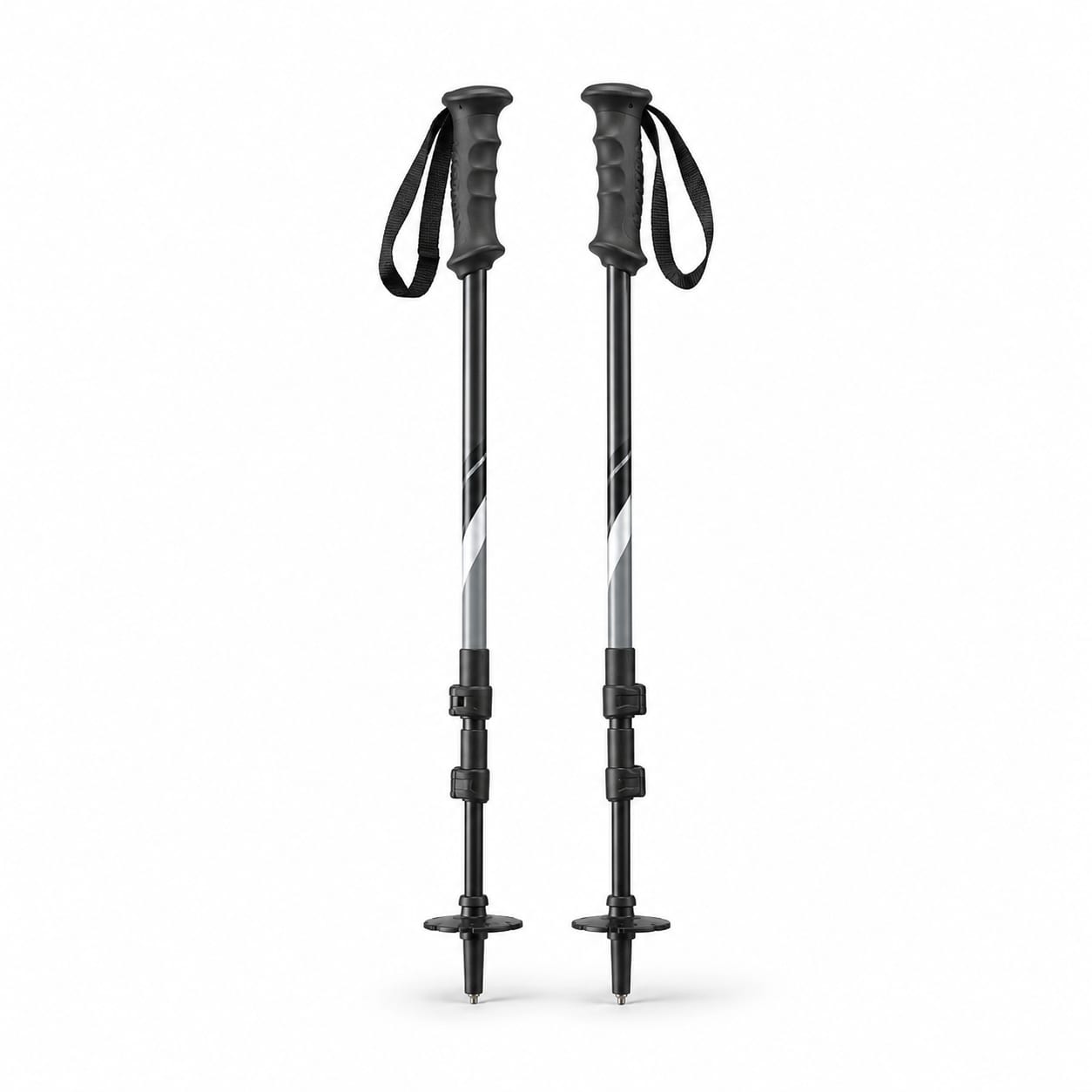
46 questions
Browse by spec group
Questions are organized the same way as the buying specs on the main equipment page.
Sizing & Fit
Dimensions that determine how the pole fits the skier's body and affects comfort and technique.
How do I figure out what length ski poles I need?
The easiest way to find your pole length is to flip a pole upside down, grab it just under the basket, and hold it at your side—your elbow should form a 90-degree angle. If you don't have a pole handy, measure from the ground to the top of your hand while your elbow is bent at 90 degrees. Most adults end up in the 110-125 cm range. Your skiing style matters too. Freeskiers and park riders often go shorter (100-110 cm) because shorter poles are easier to swing around and less awkward in tight spots. Racers sometimes prefer slightly longer poles for tucking. The biggest mistake people make is buying poles that are too long. Extra length forces your shoulders up and messes with your pole planting technique. If you're between sizes, go shorter—your shoulders will thank you after a full day on the mountain.
Read answer →Grip · Standard/CylindricalShould I stick with a standard cylindrical grip on ski poles, or is it worth paying more for an ergonomic one?
Standard cylindrical grips are the classic straight handles found on most traditional ski poles, and they remain a solid choice for good reason. Their simple, consistent shape means you get the same feel no matter how you grab the pole, which makes it easy to grip and release quickly during proper pole planting technique. They're also the most affordable option. These grips are especially well-suited for beginners, recreational skiers, and all-mountain riders who want something reliable without overthinking it. If you're not logging full-day sessions or dealing with hand fatigue, a standard grip will serve you just fine. The main tradeoff is comfort on long days. Since the straight shape doesn't contour to your hand, you may notice soreness after hours of gripping. If you frequently ski full days or have issues with hand fatigue, an ergonomic grip could be worth the upgrade. But for most casual skiers, standard grips are a proven, no-fuss choice.
Read answer →Grip · Ergonomic/ContouredShould I get ergonomic ski pole grips, and are they worth the extra cost?
Ergonomic grips are shaped with finger grooves, palm contours, or angled tops to match your hand's natural shape. If you've ever ended a ski day with cramped or aching hands, these grips can make a real difference by reducing fatigue and improving your hold on the pole. They're especially worth considering if you ski all day, deal with hand or joint issues like arthritis, or simply want a more comfortable feel. The contoured shape distributes pressure more evenly across your hand instead of concentrating it in one spot. The main catch is fit—ergonomic grips are shaped for a specific hand position, so if the angle doesn't match your natural grip, they can actually feel awkward. Try holding them before buying if possible. They also cost more than standard cylindrical grips. But for skiers who spend full days on the mountain, the comfort payoff is usually worth it.
Read answer →Grip · Pistol GripWhat's a pistol grip ski pole, and is it right for me?
A pistol grip ski pole has a T-shaped handle with a shelf that your palm rests against, similar to how you'd hold a pistol. This design gives you excellent leverage for pushing off, making it a favorite among Nordic and cross-country skiers who rely on powerful pole strokes for propulsion. Pistol grips also work well for some backcountry touring, where that secure, locked-in feel helps during long uphill slogs. The palm shelf keeps your hand from slipping, even when you're working hard. However, pistol grips aren't the best choice for most alpine resort skiing. The same secure grip that's great for touring can make it harder to quickly release the pole during fast pole plants—something you do constantly in moguls, tight trees, or quick turns. If you primarily ski inbounds at the resort, a standard or ergonomic grip is usually a better fit.
Read answer →Grip · Freeride/ExtendedWhat's the point of those extended grips on freeride ski poles, and do I actually need them?
Freeride or extended grips feature a rubberized sleeve that extends below the main grip, giving you extra real estate to hold onto. The big advantage is on steep sidehill traverses — instead of gripping your pole at full length and reaching awkwardly uphill, you can simply choke down on the extended section to keep your hands comfortable and your balance centered. These grips shine if you regularly ski steep chutes, big mountain lines, or sidecountry where you're making lots of traverses across steep slopes. They let you make quick hand-position adjustments on the fly without needing adjustable-length poles. The tradeoff is a bit of extra weight and bulk compared to standard grips. If you mostly stick to groomers, moguls, or typical in-bounds terrain, you probably don't need them. But for serious steep skiing, they're genuinely worth having — many freeride skiers consider them essential equipment.
Read answer →Grip Material · RubberAre rubber grips a good choice for ski poles, or should I consider other materials?
Rubber grips are the most popular option for good reason—they're the best all-around choice for most skiers. The textured surface gives you solid grip security even when your hands get wet from snow or sweat, and rubber provides decent insulation to keep your hands from freezing on cold chairlift rides. It also absorbs some of the shock from pole plants, which adds up over a full day on the mountain. Rubber is especially well-suited for all-mountain and general resort skiing where you just want something reliable and comfortable. The main downside is that rubber can degrade over time with UV exposure, so if you store your poles in a sunny spot, you might notice wear sooner. Quality also varies a lot between brands—a cheap rubber grip won't feel the same as a well-molded one. If you're primarily skiing resort runs and want a low-maintenance grip that performs well in most conditions, rubber is tough to beat. Just store your poles out of direct sunlight when the season ends.
Read answer →Grip Material · CorkWhy do so many backcountry skiers prefer cork grips on their poles?
Cork grips are a favorite among touring and backcountry skiers primarily because of how they handle moisture. When you're skinning uphill for hours, your hands naturally sweat, and cork does an excellent job wicking that moisture away, keeping your grip secure and your hands drier than rubber or plastic would. Another nice benefit is that cork gradually molds to the shape of your hand over time, giving you a custom fit that gets more comfortable the more you use it. It also provides decent insulation, so it doesn't feel icy cold on early morning starts like plastic grips can. The main downside is durability—heavy use can cause cork to wear down or even crumble after a few seasons. But for skiers spending long days in the backcountry, that trade-off is usually worth it for the comfort and moisture management. If you mostly ski resort laps, rubber grips are perfectly fine and tend to last longer.
Read answer →Grip Material · PlasticAre plastic grip ski poles a good choice, or should I look at other materials?
Plastic grips have their place, but they're not the best choice for most recreational skiers. Their main advantage is weight—plastic is extremely light, which is why you'll find it on race poles where every ounce counts. They're also very durable and hold up well to abuse, making them common on rental and budget poles. The downsides are significant for everyday skiing, though. Plastic conducts cold, so your hands will feel chillier on frigid days. It also gets slippery when wet, and offers almost no shock absorption when you plant your pole on hardpack. If you ski in cold conditions or tend to get cold hands easily, rubber or cork grips will be much more comfortable. Plastic grips make the most sense if you're a racer chasing every weight advantage, or if you're buying budget poles and don't ski often. For regular resort skiing, rubber is a better all-around choice, and cork is ideal if you run hot hands or spend long days touring.
Read answer →Grip Material · FoamShould I get foam grips on my ski poles, and what are they best for?
Foam grips (usually EVA foam) are a great choice if you prioritize comfort and a lightweight feel. They're soft on the hands, provide good insulation against cold poles, and are especially popular for touring and freeride skiing. One big advantage: foam works beautifully on poles with extended grip sections—those longer grip areas below the main handle that let you choke down on steep sidehills without adjusting your pole length. The main trade-off is durability. Foam can compress over time and may show wear faster than rubber or cork, especially with heavy daily use. It also tends to absorb moisture, so your grips might feel damp after a sweaty tour. If you're a backcountry skier or freerider who values comfort on long days and likes having an extended grip for varied terrain, foam is an excellent option. For resort-only skiers who want something that lasts season after season, rubber or cork might be the better long-term pick.
Read answer →Strap · Standard StrapAre standard straps on ski poles fine for most skiing, or should I upgrade to something fancier?
Standard nylon straps are the most common type for good reason—they're simple, reliable, and work well for the vast majority of skiers. Whether you're cruising groomers or exploring the whole mountain, a standard strap keeps your pole securely connected to your wrist and helps with pole planting and rhythm. The key is using them correctly: reach up through the strap from underneath, then grip over it. This creates a secure loop that supports your hand without squeezing the grip too hard. Going in from the top is a common mistake that reduces control and can cause injuries in a fall. The main downside is that standard straps don't release under force, which can lead to thumb or wrist injuries if you fall hard while the strap is engaged. If you've had strap-related injuries before or ski very aggressively, a release system like Leki's Trigger might be worth considering. But for most recreational and all-mountain skiers, standard straps are perfectly adequate and come on the majority of poles.
Read answer →Strap · Trigger S (Leki)I keep seeing Leki Trigger S poles—what's the deal with the click-in strap, and is it worth switching from regular straps?
The Leki Trigger S system replaces traditional nylon straps with a click-in mechanism that attaches your pole directly to compatible Leki gloves or strap adapters. The big advantage is safety: if you take a hard fall, the pole releases under excessive force, which can help prevent thumb and wrist injuries—a surprisingly common ski injury from standard straps getting yanked the wrong way. It's also convenient. You can click in and out of your poles instantly at the lift line without fumbling with straps, and the connection feels secure during normal skiing. The catch is that Trigger S requires Leki-compatible gloves or small strap adapters that click into the system, so you're buying into their ecosystem. It also comes at a premium price. If you've had thumb or wrist injuries from pole straps, or you just want the convenience and safety benefit, it's a worthwhile upgrade. Most casual skiers do just fine with standard straps.
Read answer →Strap · Trigger 3D (Leki)What is Leki's Trigger 3D strap system, and is it worth it over regular straps?
Leki's Trigger 3D is a proprietary click-in system that connects your pole directly to a compatible glove or strap adapter. Unlike standard nylon straps, it features a release mechanism that detaches in multiple directions during a fall, helping prevent thumb and wrist injuries. The big advantage over Leki's older Trigger S system is multi-directional release—it lets go from more angles, giving you better injury protection while still feeling totally secure during normal skiing. That's why it's popular with aggressive skiers and racers who push hard and fall harder. Two things to keep in mind: you'll need compatible Leki gloves or strap adapters, which add to the overall cost, and the system comes at a premium price. If you've ever jammed a thumb or tweaked a wrist in a pole strap fall, or you ski aggressively enough that crashes happen, the Trigger 3D is a smart investment in safety and convenience.
Read answer →Strap · Strapless/Grip OnlyShould I consider strapless ski poles, or do I really need straps?
For most alpine skiers, straps are essential and going strapless isn't recommended. Straps help you plant your poles with confidence, keep them from dropping in the snow if you lose your grip, and actually reduce fatigue by letting your hand rest between plants. Without straps, you're constantly gripping tight, which tires your hands out fast. Strapless poles do have a niche, though. They're popular in Nordic walking and some freestyle applications where you want maximum hand freedom and no risk of strap-related thumb or wrist injuries in a fall. If you're a park skier who frequently drops poles before hitting features, strapless grips can make that quicker. The big trade-off is convenience versus security. Strapless poles are easy to ditch in a crash, but they're also easy to lose mid-run when you brush a tree or take a tumble. For resort skiing, the safety and control that straps provide far outweigh the freedom of going without. If strap injuries are a concern, look into Leki's Trigger release systems instead—they give you strap security with injury-preventing quick release.
Read answer →Adjustment RangeWhat adjustment range should I look for in adjustable ski poles?
Adjustment range refers to the minimum and maximum lengths an adjustable pole can be set to — it only applies to telescopic and folding poles, not fixed-length ones. The range matters because different terrain and situations call for different pole lengths, especially in the backcountry. For backcountry touring, look for poles that adjust at least 20cm. You'll want them longer on the uphill for better reach and propulsion, and shorter on the downhill for cleaner pole plants. Common ranges include 100-125cm, 105-135cm, and 110-140cm. The key is making sure your ideal fixed-length pole size falls somewhere within the range — if you normally ski a 115cm pole, a 100-125cm range works great, but a 105-135cm range gives you more flexibility for steep ascents. Ski mountaineers who stash poles on their pack for steep climbs should look for ranges that go even shorter. Also, keep in mind that folding poles often have a more limited adjustment range than telescopic ones, so check the specs carefully if versatility is your priority.
Read answer →Construction & Materials
Dimensions related to the pole's build quality, materials, and structural design.
Are aluminum ski poles a good choice, or should I spend more for carbon fiber?
Aluminum ski poles are the best choice for most recreational and all-mountain skiers. They're durable, affordable, and forgiving—meaning if you crash or bang them against something, they'll bend rather than snap. That bend-instead-of-break quality is actually a safety advantage on the mountain. The main trade-off is weight. Aluminum poles are heavier than carbon fiber, which you might notice on long days or touring trips. They also transmit more vibration from the snow, though some skiers actually prefer that feedback for feeling the terrain. If you're a casual skier, a beginner, or just hard on your gear, aluminum makes the most sense. Save the carbon fiber investment for racing, frequent touring, or if you ski dozens of days a season and appreciate every ounce of weight savings. For most weekend resort skiers, aluminum poles get the job done reliably.
Read answer →Material · Carbon FiberAre carbon fiber ski poles worth the extra cost, or should I stick with aluminum?
Carbon fiber poles are the lightest option available, with excellent stiffness and the best vibration dampening of any material. That reduced swing weight really adds up over a full day on the mountain, making them a favorite for racers, touring skiers, and anyone who logs lots of vertical. The trade-off is durability. Unlike aluminum, which bends on impact, carbon fiber can snap under sharp impacts—like catching a pole on a gate or crashing on rocky terrain. If you're hard on your gear or mostly ski casually, that's a real downside. Carbon makes the most sense if you're performance-focused, covering long distances in the backcountry, or simply want the lightest pole possible. For most recreational skiers and beginners, aluminum offers better value and forgiveness. But if weight matters to you and you're not regularly bashing poles around, carbon is a worthwhile upgrade.
Read answer →Material · Composite/FiberglassWhat are composite ski poles, and are they a good middle ground between aluminum and carbon?
Composite ski poles blend materials like fiberglass and carbon to give you a balance of weight, durability, and price. They're lighter than aluminum but tougher than pure carbon fiber, making them a solid pick if you want something that performs well without the premium price tag. These poles really shine for all-mountain skiers who want a step up from basic aluminum but don't need—or want to pay for—full carbon. They handle impacts better than carbon, so if you occasionally bash your poles on rocks or take spills, composite won't let you down as easily. They also dampen vibrations decently, so your hands won't feel as rattled on icy groomers. The tradeoff is they're slightly heavier than pure carbon and won't give you that ultra-light swing weight racers love. But for most recreational to intermediate skiers who want versatility and durability without breaking the bank, composite hits a sweet spot.
Read answer →Material · BambooAre bamboo ski poles actually good for skiing, or are they just for looks?
Bamboo ski poles are more than just a style statement — they offer a genuinely unique feel on the hill. The natural flex of bamboo creates a lively, springy sensation that many freestyle skiers love, and the material naturally absorbs vibrations better than you might expect. Plus, they're an eco-friendly alternative to metal or synthetic shafts. That said, bamboo does come with trade-offs. Because it's a natural material, consistency can vary from pole to pole — unlike aluminum or carbon, which are manufactured to precise specs. They're also a moderate weight, so they won't give you the featherlight swing of carbon fiber. Bamboo poles make the most sense if you're an eco-conscious skier, a freestyle rider who appreciates that lively flex, or someone who values unique aesthetics on the mountain. If you need maximum durability or race-ready performance, you're better off with aluminum or carbon.
Read answer →Material · Aluminum-Carbon MixI've seen ski poles that are part aluminum and part carbon—what's the point of that mix, and is it worth it?
Aluminum-carbon mix poles combine an aluminum upper shaft with a carbon lower section, giving you the best of both materials. The aluminum near the grip adds durability where poles take the most abuse, while the carbon near the tip reduces weight where it matters most for swing feel. This hybrid design improves swing weight—how light the pole feels when you're planting and swinging it all day—without sacrificing the toughness that pure carbon poles sometimes lack. If you've ever snapped a carbon pole on a hard crash, you'll appreciate having aluminum where the stress hits hardest. These poles are a great fit for performance all-mountain skiers who want something lighter than full aluminum but more durable than full carbon. They typically cost more than aluminum but less than pure carbon, making them a smart middle-ground investment if you ski frequently and care about both weight and longevity.
Read answer →Construction · Fixed LengthAre fixed length ski poles a good choice, or should I get adjustable ones?
Fixed length poles are one solid shaft with no moving parts, making them the simplest and most reliable option out there. They're lighter than adjustable poles, more durable, and offer better stiffness for power transfer when you're planting turns. For most resort skiers, fixed poles are the way to go. The trade-off is that you can't change the length on the fly or pack them down small. If you're skiing backcountry and need shorter poles for uphill travel or longer poles for descents, adjustable or telescoping poles make more sense. Similarly, if you need poles that fit in a travel bag, fixed length won't work. But if you spend your days at the resort, fixed poles are cheaper, lighter, and less likely to fail you mid-run. No locking mechanisms to freeze up or slip under pressure—just simple, dependable performance.
Read answer →Construction · Telescopic/AdjustableShould I get telescopic ski poles, or are fixed poles fine?
Telescopic poles are a must-have if you're heading into the backcountry or ski touring. The big advantage is adjustability—you can lengthen your poles for uphill skinning (where you want more reach) and shorten them for the descent or steep traverses. That versatility makes a real difference on variable terrain. For resort skiers, though, telescopic poles are usually overkill. The locking mechanisms add weight and complexity, and they can occasionally slip under heavy pressure if not tightened properly. Fixed-length poles are simpler, lighter, more durable, and cost less—hard to beat if you're just lapping the lifts. Where telescopic poles shine is backcountry versatility and travel convenience. They pack down smaller for luggage and can be shared between users of different heights. Just make sure to check and tighten the locks before each run to avoid unexpected collapse.
Read answer →Construction · Folding/CollapsibleWhen should I choose folding ski poles over telescopic or fixed ones?
Folding ski poles are the best choice when packed size is your top priority. They collapse into sections connected by an internal cord—similar to how an avalanche probe works—making them small enough to stash inside or attach to a backpack. This makes them ideal for ski mountaineering and steep backcountry ascents where you frequently take your poles off and store them on your pack. Compared to telescopic poles, folding poles pack down smaller and are typically a bit lighter, though they don't offer length adjustment for switching between uphill and downhill modes. Compared to fixed poles, they're more packable but slightly heavier and less bombproof due to the internal cord that can stretch or wear out over time. If you're primarily doing resort skiing, fixed poles are the simpler, more durable choice. But if your adventures regularly involve stowing poles on your pack for technical climbs or travel, folding poles are worth the investment.
Read answer →Tip Material · Carbide/TungstenAre carbide tips on ski poles really worth it, or is that just a marketing upsell?
Carbide (or tungsten carbide) tips are absolutely worth it—they're the industry standard on any quality ski pole for good reason. Carbide is an extremely hard material that grips icy and hardpack snow far better than steel, giving you confident pole plants when conditions are firm. More importantly, carbide holds its sharp point season after season, while steel tips dull relatively quickly and can bend if you hit rocks. You'll find carbide tips on most mid-range and higher poles, and that's one clear sign you're looking at a pole built to last. Steel tips do show up on budget and rental poles, and they're fine for casual beginners who aren't sure they'll stick with the sport. But if you ski regularly, carbide saves you money over time since you won't be replacing or sharpening worn tips nearly as often. One quick tip: always use rubber tip covers when walking across parking lots or pavement. Carbide is tough, but grinding it on concrete will still wear it down fast.
Read answer →Tip Material · SteelAre steel tip ski poles fine for a beginner, or should I spend more for carbide?
Steel tips are perfectly fine if you're just starting out or only ski a few days a season. They grip adequately on most snow conditions and come standard on budget-friendly poles and rental equipment. For casual skiers, the performance difference won't be very noticeable. The main trade-off is durability. Steel tips dull faster than carbide and are more likely to bend if you tap rocks. Over time, a worn tip won't bite into icy surfaces as well, which can make pole plants less secure on hardpack. You may eventually need to replace or sharpen them. If you ski regularly or tackle icy groomers, carbide tips are worth the upgrade—they stay sharp much longer and grip noticeably better. But if you're a beginner still building confidence on the slopes, steel tips will serve you just fine without the extra cost.
Read answer →Tip Material · Rubber Tip CoverDo I really need rubber tip covers for my ski poles?
Rubber tip covers aren't for skiing—they're a protective accessory you'll be glad to have when you're off the snow. They slip over your pole's metal tips to prevent wear when walking across pavement, concrete, or any hard surface. Carbide and steel tips dull quickly on these surfaces, so covers are a simple way to extend the life of your poles. They're also useful around the house. Rubber covers prevent metal tips from scratching hardwood floors or tearing up gear bags during travel. Most are inexpensive and take up almost no space in your jacket pocket. The critical rule: always remove rubber covers before skiing. They provide zero grip on snow and ice, and a pole that slides instead of planting can throw off your balance or even cause a fall. Covers are strictly for parking lots, lodge walkways, and transport—never for the slopes.
Read answer →Shaft DiameterDoes ski pole shaft diameter really matter when I'm shopping for poles?
Most ski poles have a shaft diameter of 16–18mm at the grip that tapers down to 12–14mm at the tip. This tapering gives you stiffness where you need it (near your hands) while keeping swing weight low at the tip, so your poles feel lighter and more responsive as you plant them turn after turn. For most resort skiers, shaft diameter isn't something to stress over—it's rarely a primary buying factor. Where it does matter is if you're racing, where more aggressive tapering reduces aerodynamic drag, or if you're a weight-conscious backcountry skier counting every ounce. One common mistake is assuming a thicker shaft means a stronger pole. The material (aluminum vs. carbon composite, for example) matters far more than diameter when it comes to durability. Focus on material, length, and grip comfort first, and consider shaft diameter only if you're fine-tuning for racing performance or minimizing swing weight.
Read answer →Curved Shaft · Curved/BentShould I get ski poles with a curved shaft, or are straight poles fine?
Curved shaft poles are designed specifically for speed discipline racing—giant slalom, super-G, and downhill—where you spend a lot of time in a low tuck position at high speeds. The bend wraps the poles closer to your body, reducing aerodynamic drag so you can carry more speed. If you're not competing in those disciplines, curved poles offer no real advantage. For the vast majority of skiers—including all-mountain, freestyle, backcountry, and recreational riders—straight poles are the way to go. They're easier to plant and maneuver, and they cost less. Even slalom racers use straight poles because their discipline involves quick, frequent pole plants rather than sustained tucks. A common mistake is assuming curved poles are an upgrade because they're pricier, but they're actually a specialized tool for a specific job. Unless you're racing speed events, stick with straight shafts.
Read answer →Curved Shaft · StraightDo I need curved ski poles, or are straight poles fine for regular skiing?
Straight poles are the right choice for almost everyone. They're the standard design used for all-mountain skiing, freestyle, backcountry, recreational skiing, and even slalom racing. If you're skiing at a resort, hitting the park, or exploring the backcountry, straight poles are what you want. Curved or bent poles are designed specifically for speed discipline racing—giant slalom, super-G, and downhill—where tucking at high speeds makes aerodynamics critical. The bend wraps the pole around your body to reduce drag in a tuck. But at recreational speeds, that aerodynamic benefit disappears entirely. Straight poles are also easier to plant and maneuver, and they're typically less expensive. Unless you're actively competing in GS or speed events, go with straight poles and save your money for something that will actually improve your day on the hill.
Read answer →Lock Mechanism · External Clamp/FlicklockI'm looking at adjustable ski poles and see 'Flicklock' or external clamp mechanisms—what's the advantage of these over other lock types?
External clamp (often called Flicklock) mechanisms use a lever on the outside of the pole shaft that clamps down to hold your desired length. They're the most popular locking system for adjustable ski poles, and for good reason—you can quickly tighten or release them even with bulky gloves on, which is a huge plus on cold days. Another big advantage is visibility: you can clearly see when the clamp is fully closed and secure, so there's no guessing. This makes them especially reliable for backcountry touring, where you're frequently adjusting pole length for uphill climbs versus downhill runs. The main downside is that external hardware can collect ice or freeze up in very wet conditions, so it's worth occasionally clearing snow from the clamp. With basic maintenance—just keeping them clean and making sure they're properly tightened—external clamps are the most dependable choice for adjustable ski poles.
Read answer →Lock Mechanism · Internal Expander/Twist LockAre twist-lock adjustable ski poles a good choice, or should I look for something else?
Twist-lock poles use an internal expanding wedge that tightens when you rotate the shaft sections—they have a clean, streamlined look with no external hardware. They're typically found on budget-friendly adjustable poles and some trekking poles that get repurposed for skiing. The downside is that twist locks can be frustrating on the mountain. They're harder to adjust with gloves on, and in cold, wet conditions, moisture can freeze inside the mechanism, making it stick or slip. They can also collapse unexpectedly if worn or over-tightened, which is the last thing you want when you're relying on your pole for balance. If you're just cruising groomers occasionally or using poles for light snowshoeing, twist locks can work fine for the price. But for regular skiing—especially backcountry touring—external clamp-style mechanisms (like Flicklock) are far more reliable and easier to operate with cold, gloved hands.
Read answer →Lock Mechanism · Push Button/Pin LockShould I get ski poles with a push-button lock, and what are the trade-offs?
Push-button (or pin lock) ski poles use a spring-loaded button that clicks into preset holes along the shaft, locking the pole at specific length increments. They're fast to deploy—just pull the section out until the button snaps into place—and very reliable once fully engaged, since there's no clamp to forget to tighten or twist mechanism that can slip. These are most common on folding poles designed for backcountry touring or travel, where compact packability is a priority. If you want a pole that collapses down small for stashing in a pack, push-button is often the mechanism of choice. The main trade-off is that you're limited to preset lengths rather than infinite adjustability. If your ideal length falls between two holes, you'll have to pick one or the other. For most skiers the increments are close enough, but if you're particular about exact pole length, an external clamp style may be a better fit.
Read answer →Performance & Feel
Dimensions that affect how the pole performs in use, including weight, vibration, and swing characteristics.
How much should my ski poles weigh, and does weight really matter?
Ski pole weight ranges from about 180g to 600g per pair, and it definitely matters—especially over a full day on the mountain. Lighter poles reduce arm fatigue and make pole planting quicker and smoother. Most aluminum poles fall in the 400-550g range, which is comfortable for recreational resort skiing. Carbon poles are lighter, typically 180-350g, and are popular for touring and racing where every gram counts on the ascent. That said, lighter isn't always better. Poles under 250g can feel flimsy or lack the satisfying "plant" feel many skiers prefer. Ultra-light poles also sacrifice durability, so if you're hard on gear or ski mostly inbounds, a mid-weight option around 350-450g often hits the sweet spot between comfort and toughness. For touring or racing, go as light as your budget allows. For casual resort skiing, aim for under 450g and you'll be comfortable all day without overspending on weight you won't notice.
Read answer →Vibration Dampening · High DampeningShould I look for ski poles with high vibration dampening if my hands get tired and achy on long ski days?
Yes, high vibration dampening is exactly what you want if you're dealing with hand fatigue or discomfort on the mountain. Poles with high dampening absorb the constant buzzing and rattling that travels up from your pole tip on hard or choppy snow, so your hands and arms stay fresher throughout the day. These poles typically use carbon fiber construction, rubber inserts, or built-in dampening systems to soak up that vibration before it reaches your grip. They're especially nice for recreational skiers who spend full days out, ski in variable conditions, or just have sensitive hands that tend to go numb or ache. The one tradeoff is that high dampening can mute the "feel" of what's happening underfoot — some racers actually prefer low dampening because they want that feedback for timing turns. But for most all-mountain and recreational skiers, comfort wins out, and high dampening poles are a great call. If you've been using stiff aluminum poles and your hands are paying for it, upgrading to a high-dampening carbon or composite pole can make a noticeable difference.
Read answer →Vibration Dampening · Moderate DampeningWhat does moderate vibration dampening mean on ski poles, and is it a good choice for regular all-mountain skiing?
Moderate vibration dampening means the pole absorbs an average amount of the chatter and vibration that travels up from the tip when you plant on hard or choppy snow. It's what you'll typically find in standard aluminum and composite poles without any special shock-absorbing features built in. For most all-mountain and recreational skiers, moderate dampening hits the sweet spot. You get enough comfort to ski a full day without your hands feeling rattled, but you still maintain a good sense of what's happening underfoot. You might notice some buzz on really firm or icy snow, but it's rarely a dealbreaker. If you're not dealing with hand fatigue or numbness, and you're not racing at a level where you need maximum snow feedback, moderate dampening is usually the right call. It's the balanced, do-anything option that works for the majority of skiers.
Read answer →Vibration Dampening · Low DampeningWhy would anyone want ski poles with low vibration dampening? Isn't less vibration better?
Low dampening poles are designed for racers and precision-focused skiers who actually want maximum feedback from the snow. When you're carving gates or making split-second timing adjustments, feeling every vibration through the pole helps you read the terrain and react faster. That's why most stiff aluminum race poles have low dampening. The trade-off is comfort. On long days or in choppy, rough snow, all those vibrations travel straight to your hands and can cause fatigue or numbness. If you're skiing bell to bell or dealing with variable conditions, low dampening can really wear you out. So low dampening makes sense if you're racing, training, or just prefer that direct, connected feel to the snow. For most recreational skiers spending full days on the mountain, moderate or high dampening poles are the more comfortable choice.
Read answer →Basket · Standard/SmallAre standard ski pole baskets fine for most days on the mountain, or do I really need powder baskets?
Standard baskets are the right call for the majority of resort skiers. These compact discs (typically 40-50mm across) are low-profile and lightweight, making them ideal for groomed runs, hardpack, and general all-mountain skiing. They won't catch on gates, tree branches, or moguls, and their minimal air resistance is a bonus if you're into racing. The trade-off is that standard baskets will punch right through deep powder, leaving your pole sunk to the grip—which is both frustrating and potentially unsafe when you need a solid plant. If you regularly chase fresh snow off-piste or venture into the backcountry, you'll want larger powder baskets instead. For most skiers who spend 80% or more of their time on-piste, standard baskets are all you need. You can always swap to powder baskets later if your skiing evolves.
Read answer →Basket · Powder/LargeDo I really need powder baskets on my ski poles, or will standard ones work fine?
Powder baskets are those oversized discs (80-100mm+) near the pole tip, and they're designed to keep your pole from punching through deep snow. If you regularly ski powder, backcountry, or off-piste terrain, they're pretty much essential—without them, your pole can sink right up to the grip, leaving you with no stable plant when you need it most. That said, if you spend most of your time on groomed runs and hardpack, powder baskets can actually work against you. They add weight, create more drag, and can feel clunky and cumbersome when you're making quick pole plants on firm snow. Standard baskets (40-50mm) are the better choice for on-piste skiing. The bottom line: if deep snow is a regular part of your day, powder baskets are worth it. If you're mostly cruising groomers, stick with standard.
Read answer →Basket · Cone/SpeedI saw some ski poles with cone-shaped baskets instead of regular round ones. What are these for, and do I need them?
Cone baskets, also called speed baskets, are designed specifically for ski racing—particularly giant slalom and downhill events. Their streamlined shape cuts down on air resistance at high speeds, which matters when every fraction of a second counts on the race course. For most recreational skiers, cone baskets aren't necessary. They offer minimal benefit at typical skiing speeds and are actually less effective in soft snow since they don't provide much flotation. If you're skiing groomed runs, moguls, or powder, standard or powder baskets will serve you much better. Choose cone baskets only if you're competing in speed disciplines or training for racing. They're a specialized piece of equipment that solves a very specific problem—drag at race speeds—that most skiers simply don't encounter on a normal day on the mountain.
Read answer →Basket · InterchangeableAre interchangeable ski pole baskets worth it, or should I just pick one size?
Interchangeable baskets let you swap between small and large baskets depending on conditions—compact ones for groomed days and oversized powder baskets when the snow is deep. They're a great choice if you ski a mix of on-piste and off-piste terrain, or if you travel to different mountains where conditions vary widely. The trade-off is a slight weight increase from the threading mechanism, and some systems can loosen over time with repeated swapping. It's worth checking reviews on how secure a specific system feels before buying. If you almost always ski the same type of snow—like mostly groomed runs or mostly deep powder—sticking with a fixed basket that matches your primary condition is simpler and lighter. But for skiers who want one pole to handle it all, interchangeable baskets offer solid versatility without needing a second pair.
Read answer →Use Case & Discipline
Dimensions that determine the pole's intended application and suitability for different skiing styles.
I mostly ski at resorts on a mix of groomed runs and some off-piste. Are alpine/all-mountain poles the right choice for me?
Alpine/all-mountain poles are exactly what you need. They're designed as the versatile workhorse of ski poles, built to handle the variety of terrain you encounter at a resort—from smooth groomers to bumps to light powder. These poles strike a balance that makes them ideal for most recreational skiers. They feature standard basket sizes that work in most snow conditions, comfortable grips for all-day use, and durable construction that holds up to regular resort skiing. You won't get the specialized features of race or backcountry poles, but you also won't be paying for features you don't need. If 80% or more of your skiing is lift-served at resorts, alpine/all-mountain poles are your best bet. They offer the best value and will serve you well across varied terrain without the drawbacks of more specialized options.
Read answer →Discipline · RacingShould I buy racing ski poles, or are they overkill if I'm not competing?
Racing poles are built specifically for alpine race events—slalom, giant slalom (GS), super-G, and downhill. They feature aerodynamic cone-shaped baskets that cut through the air, and GS poles have a curved shaft that wraps around your body in a tuck position to reduce drag. They're also extremely lightweight, which matters when every hundredth of a second counts. However, if you're not actively racing, these poles are probably not the right choice. The specialized features that make them great on a race course make them less practical for everyday resort skiing. They tend to be more fragile than all-mountain poles, and the curved shafts and tiny baskets aren't helpful when you're cruising groomers or skiing bumps. You'd be paying a premium for features you won't benefit from. Stick with alpine/all-mountain poles for general resort skiing—they're more durable, versatile, and affordable. Save the racing poles for race day.
Read answer →Discipline · Freestyle/ParkDo I really need special poles for the terrain park, or can I just use my regular ski poles?
If you're spending most of your time hitting rails, jumps, and spinning in the terrain park, freestyle poles are worth the switch. They're intentionally shorter than standard poles, which keeps them out of the way when you're rotating or grabbing your skis. That shorter length also means less swing weight, making spins feel more natural. Freestyle poles are also built to take a beating. Park skiing means lots of impacts, falls, and pole plants on hard surfaces, so durability is key. They typically feature smaller baskets too, which reduces the chance of catching on features or snow when you're mid-trick. That said, if you only occasionally dip into the park and mostly cruise groomers or ski all-mountain, your regular poles will work fine. Freestyle poles aren't great for all-mountain skiing—the shorter length feels awkward on long runs, and you lose some of the balance and rhythm benefits that standard-length poles provide.
Read answer →Discipline · Backcountry/TouringDo I really need special poles for backcountry skiing, or can I just use my regular resort poles?
For backcountry touring, adjustable poles aren't just nice to have—they're essential. When you're skinning uphill, you'll want shorter poles for efficient stride and planting on steep terrain. On the descent, you'll lengthen them back to your normal skiing length. Fixed-length resort poles force you to compromise on one or the other. Backcountry poles are also built lighter to save energy on long ascents, and they come with powder baskets that won't punch through deep snow the way smaller resort baskets do. Many fold down compactly to attach to your pack during bootpacks or steep climbs. Using your resort poles for touring means you'll fatigue faster, struggle in deep snow, and won't have the adjustability you need for safe, efficient travel. If you're investing in backcountry gear, touring-specific poles should be on your list.
Read answer →Discipline · Nordic/Cross-CountryCan I use my regular alpine ski poles for cross-country skiing, or do I need specific Nordic poles?
Nordic poles are distinctly different from alpine poles and aren't interchangeable. They're significantly longer—often reaching your chin or higher—to maximize propulsion with each stride, whereas alpine poles only come up to your elbow area. This extra length is essential for generating power efficiently across flat or rolling terrain. They're also much lighter, since you're lifting them thousands of times during a tour, and feature specialized grips and straps that wrap around your hand for better transfer of pushing force. Alpine pole straps simply aren't designed for this repetitive pushing motion. If you're getting into classic cross-country or skate skiing, dedicated Nordic poles are a must. Using alpine poles will leave you working much harder for less forward motion, and they won't support proper technique. Nordic poles follow completely different sizing guidelines based on your height and specific discipline, so be sure to get fitted properly.
Read answer →Discipline · Freeride/Big MountainDo I need freeride/big mountain poles if I mostly ski off-piste and in deep powder?
If you're regularly chasing fresh lines outside the resort boundaries, freeride/big mountain poles are absolutely worth it. They're built specifically for the demands of aggressive off-piste skiing, with features that make a real difference when conditions get serious. The biggest advantages are extended grips and powder baskets. Extended grips let you choke down on steep sidehills and traverses without needing to adjust your pole length—super handy when you're working across a tricky slope. Powder baskets keep your poles from punching through deep snow, which is frustrating and exhausting all day. The construction is also tougher to handle variable snow and the occasional rock contact. Many freeride poles are adjustable too, so you can lengthen them for uphill approaches and shorten them for the descent. If you're mostly skiing groomed runs with occasional off-piste forays, standard all-mountain poles will serve you fine. But if big mountain lines and deep powder are your main game, these purpose-built poles are a smart investment.
Read answer →Packed LengthWhat does packed length mean for ski poles, and do I need to care about it?
Packed length is how short a pole gets when collapsed or folded down. This only matters if you need to stash your poles in a pack or suitcase — for regular resort skiing with fixed-length poles, you can ignore it entirely. If you're touring, though, packed length becomes important. Folding poles break down into short sections, typically 35–45cm, which easily fit inside a backpack for steep bootpacks or ski mountaineering. Telescopic poles only collapse to about half their extended length (50–65cm), so they'll need to strap to the outside of your pack. Fixed-length poles can't be shortened at all. The main thing to watch: don't assume telescopic poles pack as small as folding ones. If you need compact storage — for air travel, helicopter trips, or fitting poles inside your touring pack — go with folding poles. Otherwise, telescopic poles are fine for sidecountry or mellow tours where you just strap them to your pack exterior.
Read answer →