
Road Bike · FAQ
Questions about Time Trial / Triathlon Bike
Straight answers on fit, specs, and when this type makes sense — each topic has its own page with links back to the buying guide.
Open Time Trial / Triathlon Bike guide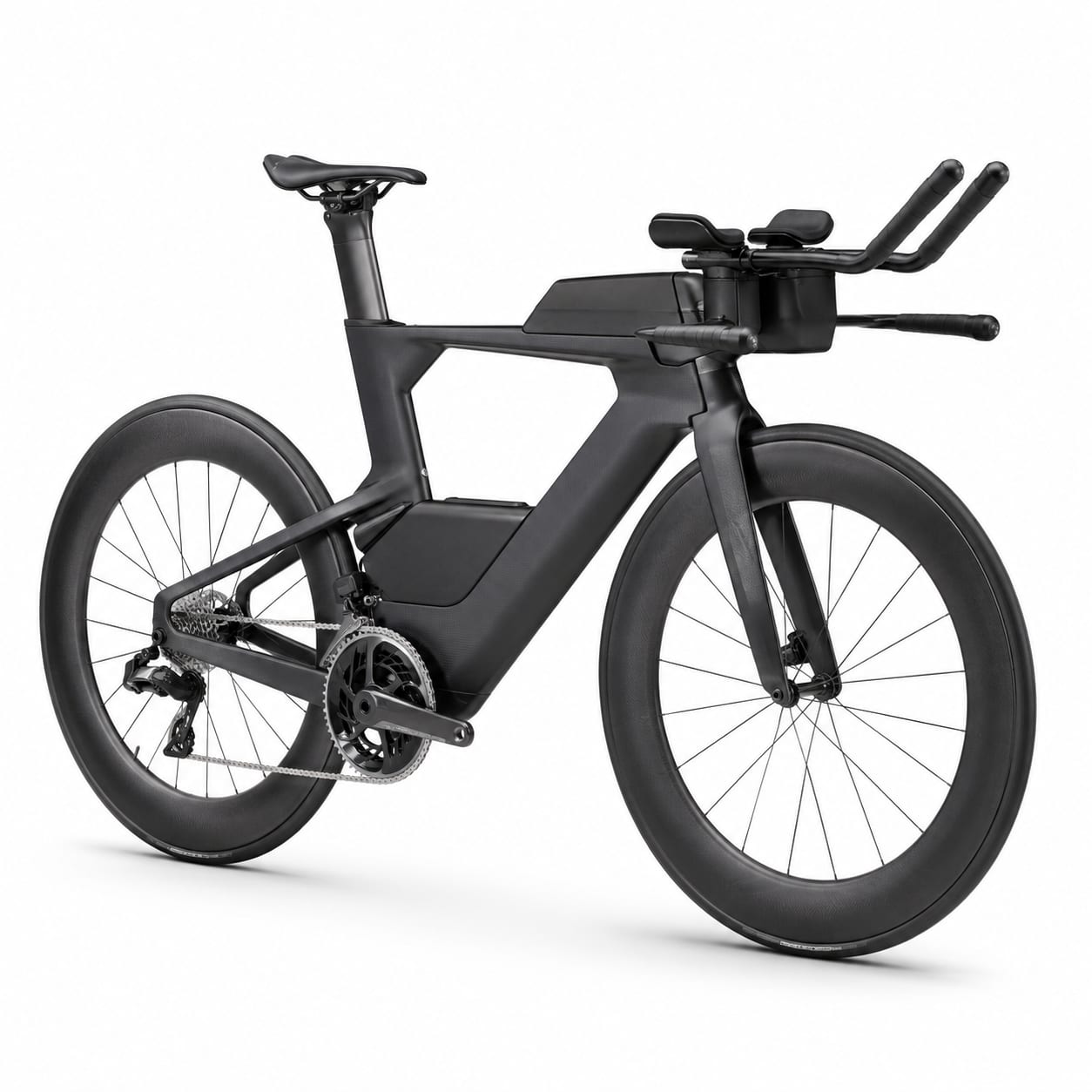
6 topics
Pick a question
Every answer links to the full subcategory guide and related gear types when it helps you decide.
Can I use a TT/Tri bike for group rides?
No, you should not use a TT/Tri bike with aerobars in group rides. The aero position places your hands far from the brakes and limits your ability to react quickly to changes in the pack. Most club rides and group cycling events prohibit aerobars for safety reasons. Use a road bike for group rides and reserve the TT/Tri bike for solo training and racing.
Read answer →02Do I need a separate bike fit for my TT/Tri bike?
Yes, absolutely. The aero position has completely different fit requirements than a road bike position, including different saddle height, fore-aft position, and front-end setup. A TT/Tri-specific fit will optimize your elbow pad width, extension length, arm angle, and saddle position for both aerodynamics and sustainable power output. Many fitters recommend doing the TT fit before purchasing to ensure you buy the correct frame size.
Read answer →03What is the difference between a UCI time trial bike and a triathlon bike?
UCI time trial bikes must comply with strict regulations on frame tube dimensions (3:1 aspect ratio), saddle position relative to the bottom bracket (5cm behind BB for most sizes), and overall bike dimensions. Triathlon bikes governed by ITU and IRONMAN rules have more freedom — steeper seat tube angles, more forward saddle positions, and deeper tube profiles are permitted. Many modern bikes offer adjustable geometry to meet both standards, but pure triathlon geometry can offer aerodynamic advantages for non-UCI events.
Read answer →04How much faster is a TT/Tri bike than a road bike?
A properly set up TT/Tri bike with an optimized aero position typically saves 30–50 watts compared to a road bike in the drops at 40 km/h, which translates to approximately 2–4 km/h higher speed for the same power output. Over a 40km time trial, this can mean 2–4 minutes faster. The exact savings depend on the rider's position, the specific bikes being compared, and the course profile. The aerodynamic advantage is most significant on flat to rolling courses at higher speeds.
Read answer →05Can I put clip-on aerobars on my road bike instead of buying a TT/Tri bike?
Clip-on aerobars on a road bike provide some aerodynamic benefit — typically 15–25 watts of savings — but significantly less than a dedicated TT/Tri bike. The road bike geometry is not optimized for the aero position: the seat tube angle is too shallow, the stack is too high, and the handling is not tuned for aero riding. Clip-ons are a reasonable starting point for beginners or budget-conscious triathletes, but serious competitors will benefit from a dedicated TT/Tri bike.
Read answer →06Are disc brakes necessary on a TT/Tri bike?
While not strictly necessary, hydraulic disc brakes are strongly recommended and are now standard on most new TT/Tri bikes. They provide superior stopping power and modulation from the aero position, where brake lever reach and leverage are compromised compared to drop bars. Disc brakes also allow wider tire clearance (28–32mm) which can improve rolling resistance and comfort on rough roads. The slight weight and aerodynamic penalty of disc brakes is outweighed by the safety and performance benefits for most riders.
Read answer →