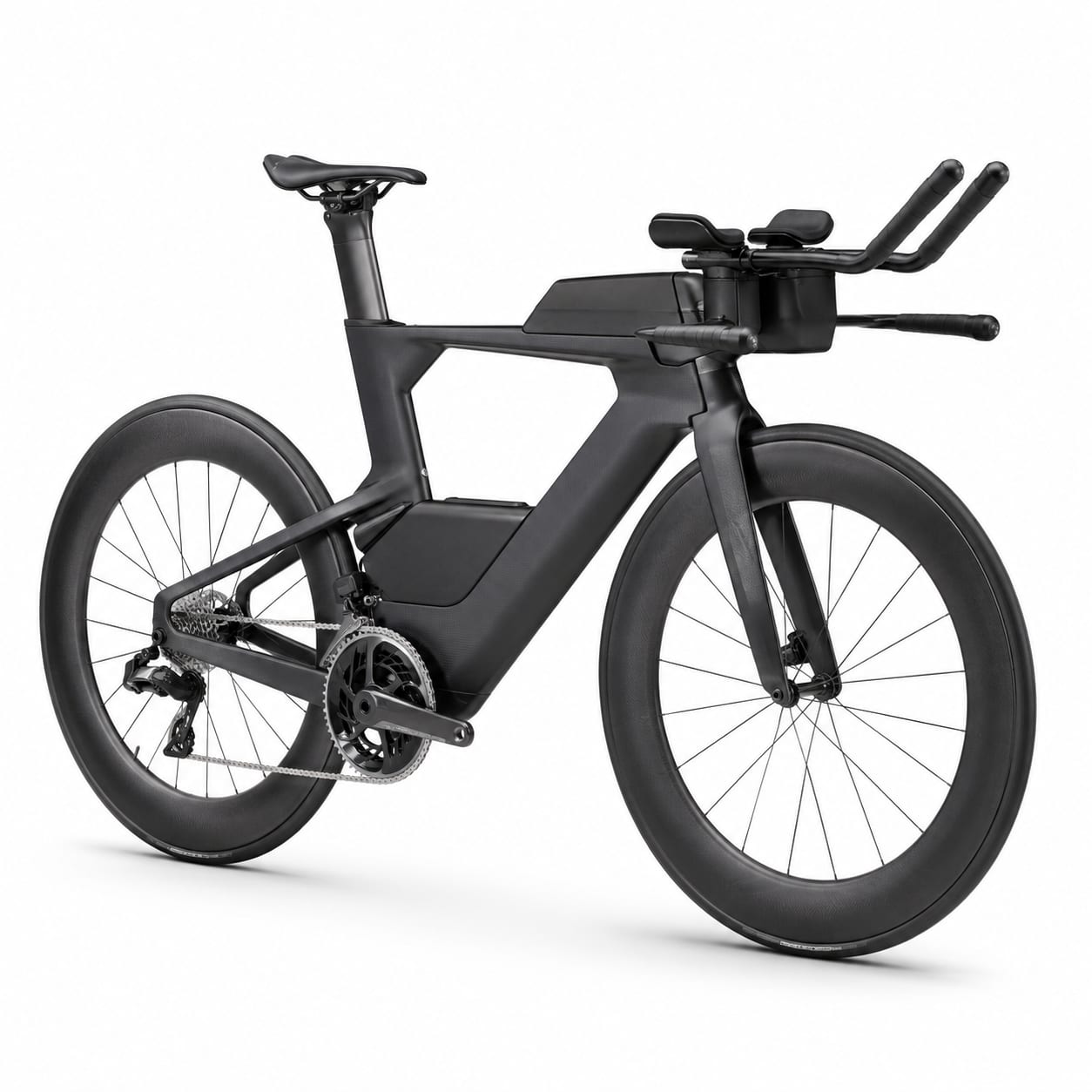
Time Trial and Triathlon bikes represent the most specialized category in road cycling, purpose-built for solo efforts against the clock where aerodynamic drag is the primary opponent. Unlike mass-start road racing bikes, TT/Tri bikes are designed around a single rider maintaining an aerodynamic tuck position for extended periods, with every frame tube, component, and cable route optimized to slice through the air with minimal resistance. The defining feature is the integrated aerobar system that positions the rider's forearms on padded rests with hands on forward extensions, dramatically reducing frontal area compared to traditional drop handlebars. The geometry is distinct from other road bikes, featuring steep seat tube angles (typically 75–78° versus 72–74° on standard road bikes) that position the rider further forward over the bottom bracket, opening the hip angle for powerful pedaling while maintaining a low aero position. Head tubes are short, reach is long, and the entire cockpit is designed around achieving the lowest sustainable riding position possible. Frame construction is almost exclusively carbon fiber, allowing engineers to create complex airfoil shapes with precisely tuned stiffness in high-load areas like the bottom bracket and head tube, while maintaining compliance in the seatpost and rear triangle to absorb road vibration during long efforts. Modern TT/Tri bikes feature full internal cable routing through proprietary aerobars, hidden brake calipers, integrated hydration systems, and storage compartments designed into the frame itself. The UCI imposes strict dimensional regulations for time trial bikes used in sanctioned events (3:1 aspect ratio on tubes, minimum saddle setback, maximum frame dimensions), while triathlon-specific bikes have more freedom in design, allowing for steeper angles and more radical aerodynamic solutions. This distinction is important — a triathlon bike may not be legal for a UCI time trial, and vice versa, though many modern designs attempt to satisfy both sets of rules with adjustable geometry.
Time Trial and Triathlon bikes occupy a unique space in cycling — they are the most aerodynamically refined machines in the sport, yet they are also among the most misunderstood. Many riders assume that a TT bike is simply a road bike with aerobars attached, but the reality is far more complex. The entire frame geometry is built around the aero position, with steep seat tube angles that shift the rider's weight forward, short head tubes that enable an extremely low front end, and chainstay and wheelbase dimensions tuned for stability at high speeds in a narrow, wind-cheating posture. The aerodynamic savings are substantial: a well-designed TT bike with an optimized rider position can save 30–50 watts compared to a standard road bike at race speeds, a difference that translates to minutes over an Ironman bike leg or a 40km time trial.
The choice between a UCI-legal time trial bike and a triathlon-specific bike is one of the first decisions a buyer must make. UCI regulations govern frame tube dimensions, saddle position relative to the bottom bracket, and overall bike dimensions, which constrains how aggressive the design can be. Triathlon bikes, governed by ITU and WTC/IRONMAN rules, have more latitude — steeper seat tube angles, more forward saddle positions, and deeper tube profiles are all permitted. For triathletes who will never race a UCI time trial, a triathlon-specific geometry offers meaningful aerodynamic advantages. However, many manufacturers now produce bikes with adjustable geometry that can meet both standards, using reversible seatpost heads or sliding saddle clamp systems that allow the rider to shift between UCI-legal and triathlon-optimized positions.
Fit is paramount with TT/Tri bikes — more so than any other road bike category. Because the rider spends the vast majority of time in the aero position, the relationship between elbow pad width, arm extension length, saddle fore-aft position, and saddle height determines both comfort and power output over long efforts. A bike that is too long or too low will cause neck strain, numb hands, and reduced power output within minutes. A professional bike fit specifically for the aero position is not optional — it is essential. Many fitters recommend starting with a fit before purchasing, as the stack and reach requirements for your optimal aero position may differ significantly from what you expect based on your road bike sizing. Some riders discover they need a size different from their road bike, or that a particular brand's geometry simply does not accommodate their position.
The component specification of TT/Tri bikes differs from standard road bikes in several key ways. Shift levers are mounted on the aerobar extensions (bar-end shifters) or integrated into the brake levers at the base bar, with electronic shifting being particularly valuable since it allows shift buttons to be placed in multiple locations. Gearing tends toward larger chainrings (53/39 or even 55/42) since TT courses are typically flatter and higher speeds demand bigger gears, though triathletes on hilly courses may prefer compact gearing. Brake calipers are often tucked behind the fork and under the chainstays for aerodynamic benefit, which can make wheel changes and brake adjustment more difficult. Hydraulic disc brakes are increasingly standard, offering superior modulation and stopping power from the aero position, though some weight-obsessed builds still use rim brakes.
Training and racing on a TT/Tri bike requires specific skills that do not transfer directly from road bike riding. Handling is different — the aero position places more weight on the front wheel and reduces the rider's ability to react quickly, making technical descents and tight corners more challenging. Many triathletes practice handling skills in the aero position extensively before racing. The riding position also engages different muscle groups, with more quadriceps emphasis and less glute involvement compared to a standard road position, which means training must adapt to build endurance in this position. For triathletes, the bike leg is followed by a run, so the forward position is designed partly to preserve running muscles — the steeper seat tube angle opens the hip angle and reduces the load on the hamstrings compared to a shallower road bike position, facilitating a faster transition to running.