
Ski Bindings · FAQ
Questions about Hybrid AT Bindings
Straight answers on fit, specs, and when this type makes sense — each topic has its own page with links back to the buying guide.
Open Hybrid AT Bindings guide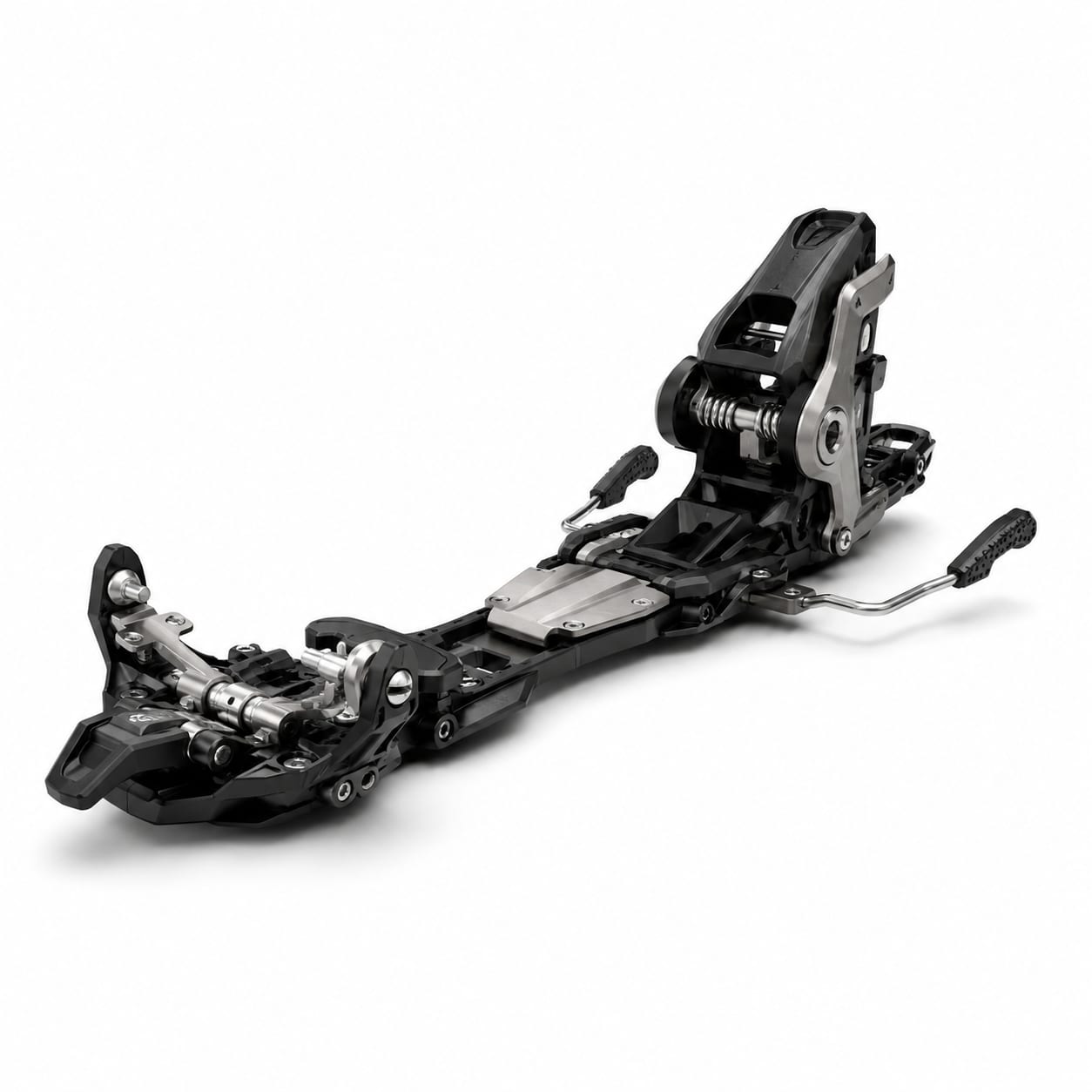
6 topics
Pick a question
Every answer links to the full subcategory guide and related gear types when it helps you decide.
Can I use my regular alpine boots with hybrid AT bindings?
Only for the downhill/ski mode—and only if the binding accepts ISO 5355 soles. For touring mode, you need boots with tech fittings (the metal sockets on the toe that accept the binding's pins). Standard alpine boots lack these fittings, so you cannot tour with them. Most hybrid binding users wear touring boots with tech fittings and GripWalk or ISO 9523 soles, which work in both modes.
Read answer →02How do I transition from tour mode to ski mode?
First, clear any snow or ice from the toe piece and boot toe. Step into the heel piece as you would with an alpine binding—the brake will deploy. Then flip the lever on the toe piece to close the toe jaws over the boot toe. You should hear and feel a positive click. Make sure the jaws are fully closed before skiing. Practice this at home before heading into the backcountry.
Read answer →03Are hybrid AT bindings safe for resort skiing?
Yes. In ski mode with the toe jaws closed, hybrid bindings function similarly to alpine bindings with a sliding AFD, lateral and upward toe release, and standard elastic travel. They carry ISO 9462 (alpine) certification in addition to ISO 13992 (touring) certification. For most skiers, the downhill safety performance is comparable to a mid-range alpine binding. The higher stand height is the main difference you may notice.
Read answer →04Will I notice the extra weight compared to pin bindings on tours?
Yes, especially on longer tours. At 1400–1800g per pair versus 600–900g for lightweight pin bindings, the difference of 500–1000g per pair is significant. Weight on your feet is felt roughly 3x more than weight in your pack. For day tours of 2–4 hours, most skiers find the weight acceptable. For longer approaches or multi-day tours, the weight penalty becomes more noticeable and may influence your decision.
Read answer →05Do hybrid bindings work well in icy conditions?
The main concern with hybrid bindings in icy conditions is the toe piece transition mechanism. Ice and frozen snow can accumulate in the pin channels and around the toe jaws, making it difficult to switch between modes or achieve full jaw closure. Always clear ice from the mechanism before transitioning. In ski mode, the binding performs normally on icy snow—the alpine-style engagement provides good retention. Some models are more prone to icing than others due to design differences.
Read answer →06Should I get hybrid bindings or separate alpine and pin binding setups?
It depends on your budget, storage space, and how much you value optimization versus convenience. Separate setups give you the best performance in each mode—the lightest possible touring setup and the best alpine binding for resort days. Hybrid bindings give you 85–90% of the performance in each mode with the convenience of one setup. If you ski resort 40–60% of the time and tour the rest, hybrid bindings are usually the right call. If you ski 90%+ resort or 90%+ backcountry, dedicated setups make more sense.
Read answer →