What it means
The total length of the snowboard measured in centimeters from tip to tail. The primary sizing dimension affecting stability, float, and maneuverability.
Typical for this type
155-170 cm
Most common pick: 162 cm
In practice
Freeride boards are typically ridden 3-5 cm longer than all-mountain boards to increase surface area for powder float and extend the effective edge for high-speed stability.
Compared to other types
Longer than freestyle and all-mountain boards, similar to powder boards, but optimized for aggressive riding rather than pure cruising.
Why it matters: A longer board prevents the nose from diving in deep snow and provides the necessary chassis length to track straight at high speeds in variable conditions.
What it means
The narrowest point of the snowboard's running surface, measured in millimeters. Determines boot-to-edge leverage and toe drag risk.
Typical for this type
250-268 mm
Most common pick: 258 mm
In practice
Slightly wider waists are common to increase surface area for float, but not so wide that edge-to-edge transitions become sluggish on steep terrain.
Compared to other types
Wider than freestyle and carving boards, but often slightly narrower than dedicated powder boards to maintain carving performance.
Why it matters: Balancing float with edge control is critical; too narrow and you sink, too wide and the board feels sluggish when initiating quick turns in trees or chutes.
What it means
The longitudinal curvature of the snowboard when laid flat. The single most influential design element on how a board feels and performs.
Typical for this type
Directional Camber, Hybrid Camber
In practice
Directional camber provides a rockered or early-rising nose for float combined with traditional camber underfoot for maximum edge hold and pop.
Compared to other types
Unlike full rocker or flat profiles, freeride boards rely heavily on camber zones for high-speed edge integrity, differing from twin boards by having a specific nose/tail profile.
Why it matters: The camber underfoot is essential for driving power into steep, icy turns, while the rockered nose keeps the board from submerging in deep snow.
What it means
The outline symmetry of the snowboard. Determines stance positioning, switch capability, and intended riding direction.
Typical for this type
Directional, Tapered Directional
In practice
Directional and tapered directional shapes feature a distinct, larger nose and a smaller, stiffer tail designed to be ridden primarily forward.
Compared to other types
Unlike true twins (freestyle) or directional twins (all-mountain), freeride shapes are completely optimized for forward riding and offer poor switch capability.
Why it matters: The shape naturally drives the board forward, allowing the wider nose to plane over snow while the narrower tail sinks slightly, enhancing float and driving power into the back foot.
What it means
The stiffness of the snowboard, typically rated on a 1–10 scale. Affects responsiveness, stability, and ease of turning.
Typical for this type
7-10
Most common pick: 8
In practice
Stiff flex profiles prevent the board from chattering at high speeds and provide the necessary torque to hold an edge on steep, firm terrain.
Compared to other types
Significantly stiffer than freestyle (3-5) and all-mountain (5-7) boards, matching or exceeding the stiffness of carving boards but with a different flex distribution.
Why it matters: A stiff board acts as a stable platform when charging through choppy snow or dropping into steep couloirs where a soft board would buckle or wash out.
Sidecut Radius
Sidecut Radius
What it means
The radius of the imaginary circle formed by the board's edge curve. Determines the natural turning radius of the board.
Typical for this type
7.0-9.5 m
Most common pick: 8.0 m
In practice
Freeride boards often use a multi-radius sidecut, allowing for tight turns in trees and chutes, as well as long, sweeping carves on open faces.
Compared to other types
Often larger than freestyle sidecuts for high-speed stability, but frequently utilizes multi-radius designs for more versatility than a pure alpine board.
Why it matters: A versatile sidecut allows the rider to adapt to rapidly changing terrain, making quick adjustments in technical spots without losing stability at speed.
Effective Edge
Effective Edge Length
What it means
The length of the edge that actually contacts the snow during a turn, measured in centimeters. Excludes the tip and tail kick areas.
Typical for this type
120-140 cm
Most common pick: 128 cm
In practice
Freeride boards maximize effective edge relative to their overall length to ensure maximum grip and stability when carving at high speeds.
Compared to other types
Longer effective edge than freestyle and park boards of similar overall length, as freeride shapes minimize the tip/tail kick to extend the contact points.
Why it matters: More effective edge means more of the board is engaged in the snow, which is critical for holding a line on steep, icy, or variable terrain.
Stance Setback
Stance Setback
What it means
How far back from the board's center the reference stance position is placed, measured in millimeters. Affects float and directional performance.
Typical for this type
20-40 mm
Most common pick: 30 mm
In practice
A significant stance setback shifts the rider's weight toward the tail, naturally lifting the nose in deep snow and providing leverage over the back foot for driving turns.
Compared to other types
Much more setback than freestyle (0mm) or all-mountain (0-15mm) boards, though slightly less than dedicated powder boards (40mm+).
Why it matters: Setback is a primary mechanism for powder float; it allows the board to plane effortlessly without the rider having to aggressively lean back.
Rider Weight Range
Recommended Rider Weight Range
What it means
The manufacturer's recommended rider weight range for optimal board performance. The most important sizing factor beyond board length.
Typical for this type
60-105 kg
Most common pick: 70-90 kg
In practice
Because freeride boards are stiff, riders must be heavy enough to flex the board into a turn; sizing up in length often corresponds to heavier weight classes.
Compared to other types
Weight recommendations often skew heavier than freestyle boards of the same length due to the increased stiffness and construction materials.
Why it matters: A rider who is too light for a stiff freeride board will struggle to initiate turns and will be bucked around, while a rider who is too heavy will overpower the flex and bottom out.
Terrain / Riding Style
Terrain / Riding Style
What it means
The primary terrain and riding style the board is designed for. The most fundamental categorization used by brands and retailers.
Typical for this type
Freeride, Powder
In practice
Designed specifically for off-piste riding, backcountry descents, steep faces, and deep snow.
Compared to other types
More specialized than all-mountain, less trick-oriented than freestyle, and more hard-charging than pure powder boards.
Why it matters: The entire design of the board—from shape to flex—is optimized for ungroomed terrain, making it a specialized tool rather than a resort cruiser.
Ability Level
Ability Level
What it means
The rider skill level the board is designed and optimized for.
Typical for this type
Advanced, Expert
In practice
The stiff flex and aggressive handling require strong technique, physical strength, and confident riding to control effectively.
Compared to other types
Far less forgiving than beginner or intermediate boards; requires more precise input than all-mountain or freestyle boards.
Why it matters: An under-skilled rider on a freeride board will find it exhausting, unresponsive, and prone to catching edges at low speeds.
Core Material
Core Material
What it means
The primary wood or composite material forming the board's internal structure. Affects weight, flex, pop, and dampening.
Typical for this type
Asp Enhanced, Paulownia
In practice
Aspen enhanced with denser wood stringers (like ash or maple) provides the perfect balance of lightweight dampening and targeted stiffness for high-speed stability.
Compared to other types
More likely to feature premium, multi-wood cores than basic poplar freestyle boards, and prioritizes dampening over the ultra-lightweight focus of some splitboards.
Why it matters: At high speeds in choppy snow, a high-quality core prevents the board from vibrating (chattering) and provides a smooth, predictable ride.
Base Material
Base Material
What it means
The material on the board's running surface that contacts the snow. Affects speed, durability, and maintenance requirements.
Typical for this type
Sintered, Sintered High Density
In practice
Sintered bases are standard to provide the high speed needed for flat traverses in the backcountry and momentum for long, open faces.
Compared to other types
Almost exclusively sintered, unlike freestyle or beginner boards which may use extruded bases for lower maintenance and rail durability.
Why it matters: Speed is safety and fun in freeride; a slow base means getting stuck in flat sections of the backcountry or losing momentum in deep snow.
Nose/Tail Shape
Nose and Tail Shape
What it means
The geometric shape of the board's tip and tail, affecting float, plow-through, and swing weight.
Typical for this type
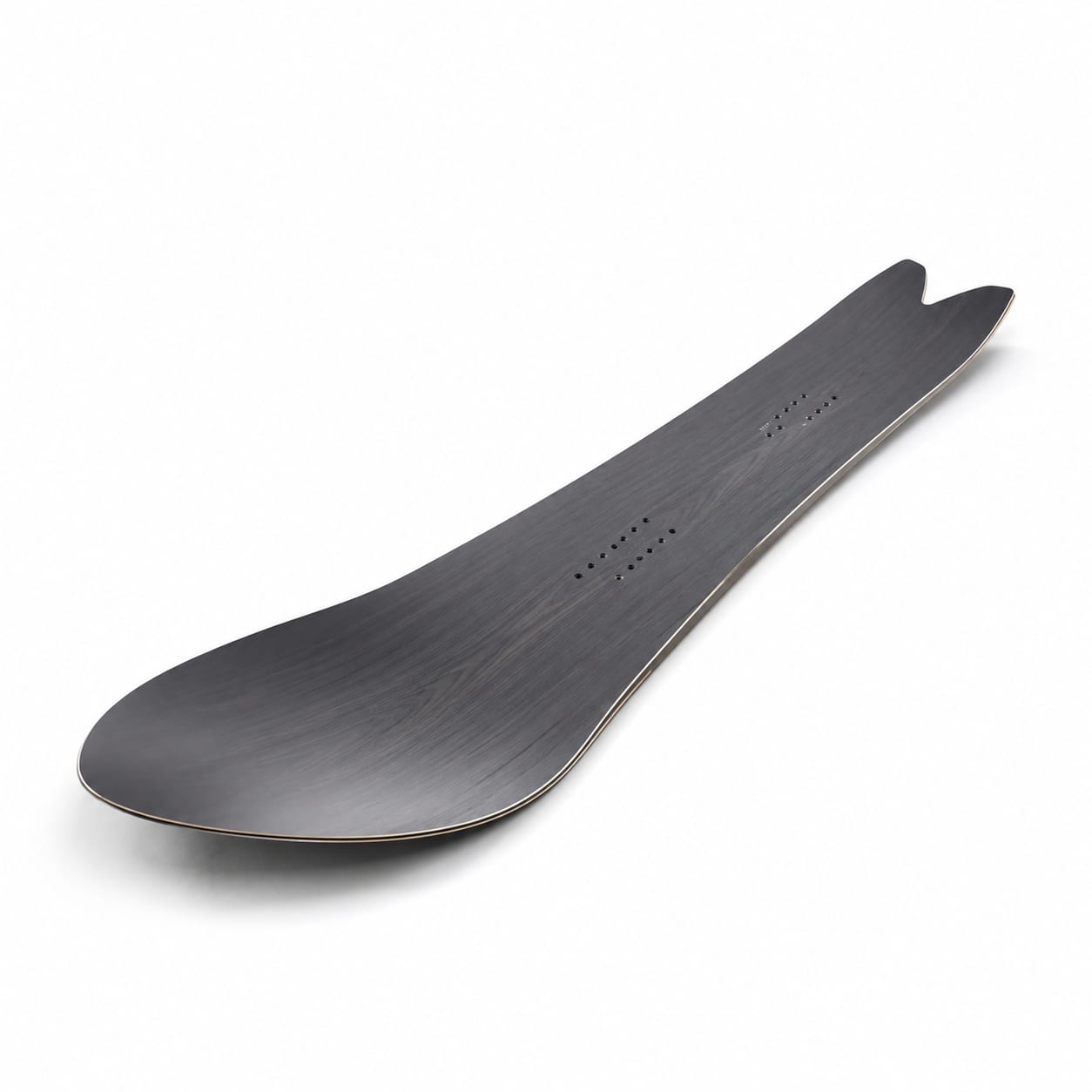
Pointed, Swallow Tail, Forked
In practice
Pointed noses slice through chop and displace snow efficiently. Swallow or forked tails allow the tail to sink in powder for enhanced float and a surfy feel.
Compared to other types
Unlike the blunt shapes of freestyle boards, freeride noses are streamlined for displacement; swallow tails are a unique feature rarely seen outside this subcategory.
Why it matters: The nose shape affects how the board plows through variable snow, while the tail shape dictates how the board finishes a turn and floats in deep powder.
What it means
The difference between the nose width and tail width of the board, measured in millimeters. Greater taper enhances powder float.
Typical for this type
4-20 mm
Most common pick: 10 mm
In practice
Taper means the nose is wider than the tail, which naturally forces the tail to sink and the nose to rise in deep snow, enhancing directional float.
Compared to other types
Much more taper than freestyle or all-mountain boards (which are typically 0-2mm), though slightly less than dedicated powder boards (15-30mm) to maintain some hardpack performance.
Why it matters: Taper is a key design element for powder performance, allowing the board to plane easily without requiring the rider to lean back excessively.
Insert Pattern
Insert Pattern
What it means
The bolt hole pattern on the board for mounting bindings. Determines binding compatibility and stance adjustability.
Typical for this type
2x4, 4x4, Channel
In practice
Standard insert patterns allow for micro-adjustment of the stance to dial in the perfect setback position for different snow conditions.
Compared to other types
Functionally similar to other subcategories, but riders utilize the inserts specifically to adjust setback, whereas park riders adjust for width and centering.
Why it matters: Being able to adjust stance setback by a few millimeters can drastically change how the board handles in powder versus hardpack.