What it means
The total length of the snowboard measured in centimeters from tip to tail. The primary sizing dimension affecting stability, float, and maneuverability.
Typical for this type
155–172 cm
Most common pick: 162 cm
In practice
Powder boards tend to run longer than all-mountain boards of the same rider weight to provide additional surface area for float. Many riders size up 3–5 cm from their standard board length.
Compared to other types
Powder boards are typically 3–8 cm longer than freestyle boards and 2–5 cm longer than all-mountain boards for the same rider, prioritizing float over agility.
Why it matters: Extra length increases the planing surface, helping the board stay on top of deep snow. However, going too long reduces maneuverability in tight trees and makes the board sluggish in quick transitions.
What it means
The narrowest point of the snowboard's running surface, measured in millimeters. Determines boot-to-edge leverage and toe drag risk.
Typical for this type
252–272 mm
Most common pick: 260 mm
In practice
Powder boards feature wider waists than most categories to increase overall surface area. The wide nose that characterizes powder boards naturally requires a wider waist as well, even before considering taper.
Compared to other types
Powder boards run 5–15 mm wider at the waist than freestyle boards and 3–10 mm wider than all-mountain boards, reflecting the priority of float over edge-to-edge quickness.
Why it matters: A wider waist provides more surface area underfoot for float and stability in soft snow. Riders with larger boots (US 11+) will find powder boards naturally accommodate their size without needing a separate 'wide' model.
What it means
The longitudinal curvature of the snowboard when laid flat. The single most influential design element on how a board feels and performs.
Typical for this type
Rocker, Hybrid Rocker, Directional Camber
In practice
The most common powder profiles feature a rockered nose for float combined with camber underfoot or in the tail for drive and pop. Full rocker profiles offer maximum float but less power, while directional camber provides a balance of float and energetic turn exit.
Compared to other types
Unlike freestyle boards (which favor twin hybrid profiles) and all-mountain boards (which favor hybrid camber), powder boards prioritize nose rocker and tail engagement, making directional_camber and hybrid_rocker the dominant profiles.
Why it matters: The rockered nose is critical for powder performance—it allows the tip to rise naturally without rider input. Camber under the back foot provides the push and response needed to drive out of turns and maintain speed in deep snow.
What it means
The outline symmetry of the snowboard. Determines stance positioning, switch capability, and intended riding direction.
Typical for this type
Directional, Tapered Directional
In practice
Tapered directional is the defining shape of powder boards, with a wider nose and narrower tail creating natural float. Directional shapes without taper are common in powder-oriented all-mountain boards that need more hardpack capability.
Compared to other types
Powder boards are exclusively directional or tapered directional, unlike freestyle boards (true twin) and all-mountain boards (directional twin). This is the category where taper is not just accepted but expected and celebrated.
Why it matters: Taper is the single most important shape factor for powder performance. A wider nose resists sinking while a narrower tail penetrates deeper, naturally angling the board for planing. The more taper, the more effortless the float—but the less capable the board becomes on groomers and riding switch.
What it means
The stiffness of the snowboard, typically rated on a 1–10 scale. Affects responsiveness, stability, and ease of turning.
Typical for this type
5–8
Most common pick: 6
In practice
Powder boards range from medium-soft (5) for a surfy, playful feel to stiff (8) for aggressive charging in heavy snow. The sweet spot for most riders is medium to medium-stiff (6–7), providing enough backbone to drive through deep snow without being punishing.
Compared to other types
Powder boards are generally stiffer than freestyle boards (2–5) and similar to or slightly stiffer than all-mountain boards (5–7), reflecting the need to drive through resistance in deep snow.
Why it matters: Stiff flex helps the board push through heavy, wet powder and chopped-up snow at speed, while softer flex offers a more playful, surfy feel in lighter snow. Too soft and the board will fold in heavy snow; too stiff and it becomes fatiguing and unforgiving.
Sidecut Radius
Sidecut Radius
What it means
The radius of the imaginary circle formed by the board's edge curve. Determines the natural turning radius of the board.
Typical for this type
7.0–10.0 m
Most common pick: 8.0 m
In practice
Powder boards tend toward medium-to-large sidecut radii to accommodate the longer, sweeping turns natural in deep snow. Many feature multi-radius or progressive sidecuts that initiate turns easily but allow for long, powerful arcs.
Compared to other types
Powder boards typically have larger sidecut radii than freestyle boards (6–8m) and similar to freeride boards (7–10m), prioritizing stability at speed over tight turn initiation.
Why it matters: In powder, you're carving the snow itself rather than the hard surface beneath, so tight sidecut radii are less necessary. A larger radius supports the flowing, high-speed turns that are most fun in deep snow, while a multi-radius design adds versatility for tighter tree runs.
Effective Edge
Effective Edge Length
What it means
The length of the edge that actually contacts the snow during a turn, measured in centimeters. Excludes the tip and tail kick areas.
Typical for this type
118–140 cm
Most common pick: 125 cm
In practice
Despite their longer overall length, powder boards often have shorter effective edges than expected because the rockered nose and tail sections don't contribute to edge contact. This is by design—less effective edge means easier turn initiation in soft snow.
Compared to other types
Powder boards have shorter effective edges relative to their total length compared to all-mountain and freeride boards, due to extended rockered zones. A 162cm powder board may have the same effective edge as a 157cm all-mountain board.
Why it matters: In deep powder, edge hold is less critical since you're turning against the snow itself rather than a hard surface. A shorter effective edge makes the board feel nimble despite its length. On groomers, however, the reduced edge contact becomes noticeable with less grip on firm snow.
Stance Setback
Stance Setback
What it means
How far back from the board's center the reference stance position is placed, measured in millimeters. Affects float and directional performance.
Typical for this type
25–55 mm
Most common pick: 35 mm
In practice
Powder boards feature the most setback of any category, typically 25–40mm for versatile powder shapes and 40–55mm for deep-day specialists. This places the rider's weight toward the tail, helping the nose rise in soft snow.
Compared to other types
Powder boards have 2–5 times more setback than all-mountain boards (10–20mm) and significantly more than freestyle boards (0mm). This is one of the defining dimensional differences of the category.
Why it matters: Significant setback is essential for powder float. It shifts your center of gravity rearward so that the nose naturally planes upward without requiring you to lean back aggressively. More setback equals more float but less switch capability and a more pronounced directional feel.
Rider Weight Range
Recommended Rider Weight Range
What it means
The manufacturer's recommended rider weight range for optimal board performance. The most important sizing factor beyond board length.
Typical for this type
55–115 kg
Most common pick: 65–100 kg
In practice
Weight range is especially critical for powder boards because the board must support the rider on top of soft snow. Riders at the lower end of the range get easier float and a more playful feel; riders at the upper end get more drive and control but need to ensure adequate board size for their weight.
Compared to other types
Powder boards often have slightly shifted weight ranges compared to all-mountain boards of the same length, as the wider shape and float-oriented design can support slightly heavier riders at a given length.
Why it matters: In powder, being too heavy for your board means you'll punch through the snow surface rather than planing on it. Being too light means the board may feel stiff and unresponsive. Always prioritize the manufacturer's weight range—more so for powder boards than any other category.
Terrain / Riding Style
Terrain Type
What it means
The primary terrain and riding style the board is designed for. The most fundamental categorization used by brands and retailers.
Typical for this type
Powder, Freeride
In practice
Powder boards are classified primarily as powder terrain type, with many also qualifying as freeride due to their capability in steep, off-piste terrain. The two categories overlap significantly—powder boards handle the deep snow aspects of freeriding, while freeride boards handle the steep, technical aspects.
Compared to other types
Powder boards are the most terrain-specific category, unlike all-mountain boards designed for everything. They share terrain overlap with freeride boards but prioritize deep snow over steep technical terrain.
Why it matters: Understanding the terrain type helps set expectations. A pure powder board will be magical in deep snow but compromised on groomers, while a freeride-leaning powder board will handle more varied terrain but sacrifice some float in the deepest conditions.
Ability Level
Ability Level
What it means
The rider skill level the board is designed and optimized for.
Typical for this type
Intermediate, Advanced, Expert
In practice
Most powder boards are designed for intermediate-to-expert riders. The directional shapes, setback stances, and stiffer flexes require some experience to manage effectively. However, the float-oriented design can actually make deep snow more accessible for intermediates who struggle with powder on standard boards.
Compared to other types
Powder boards skew more advanced than all-mountain boards (which include beginner models) and freestyle boards (which often cater to intermediates). There are very few beginner-specific powder boards on the market.
Why it matters: An intermediate rider on a powder board will have a much easier time in deep snow than on an all-mountain board, as the design does much of the float work for you. However, the same board may feel unwieldy on groomers and impossible to ride switch, requiring honest assessment of where you actually ride.
Core Material
Core Material
What it means
The primary wood or composite material forming the board's internal structure. Affects weight, flex, pop, and dampening.
Typical for this type
Paulownia, Asp Enhanced, Poplar
In practice
Paulownia is the most popular core material for powder boards due to its excellent strength-to-weight ratio. Lighter cores reduce swing weight in the extended nose area and decrease overall fatigue during long powder sessions. Many premium models use paulownia combined with denser stringers for targeted stiffness.
Compared to other types
Powder boards use paulownia more frequently than all-mountain boards (which favor poplar) and freestyle boards (which use a mix). The emphasis on weight savings is unique to this category and splitboards.
Why it matters: Weight matters more in powder boards than most categories because the extended nose and wider shape add material. A lighter core keeps the board manageable and reduces the effort required to initiate turns in deep snow. However, some riders prefer the dampening of slightly heavier cores for charging through chop.
Base Material
Base Material
What it means
The material on the board's running surface that contacts the snow. Affects speed, durability, and maintenance requirements.
Typical for this type
Sintered, Sintered High Density
In practice
Sintered bases are standard on powder boards because speed is essential for planing in deep snow. You need momentum to stay on top of soft snow, and a slow base makes powder riding significantly harder work. High-end models often feature sintered high-density bases for maximum speed.
Compared to other types
Powder boards almost exclusively use sintered bases, unlike freestyle boards where extruded bases are common for low maintenance and durability on rails. The speed requirement in powder makes sintered non-negotiable for serious riders.
Why it matters: In deep snow, losing speed means sinking. A sintered base holds wax longer and provides the glide needed to maintain momentum through flat sections and between turns. An unwaxed sintered base will still outperform an extruded base in powder, but regular waxing maximizes the advantage.
Nose/Tail Shape
Nose and Tail Shape
What it means
The geometric shape of the board's tip and tail, affecting float, plow-through, and swing weight.
Typical for this type
Pointed, Swallow Tail, Forked
In practice
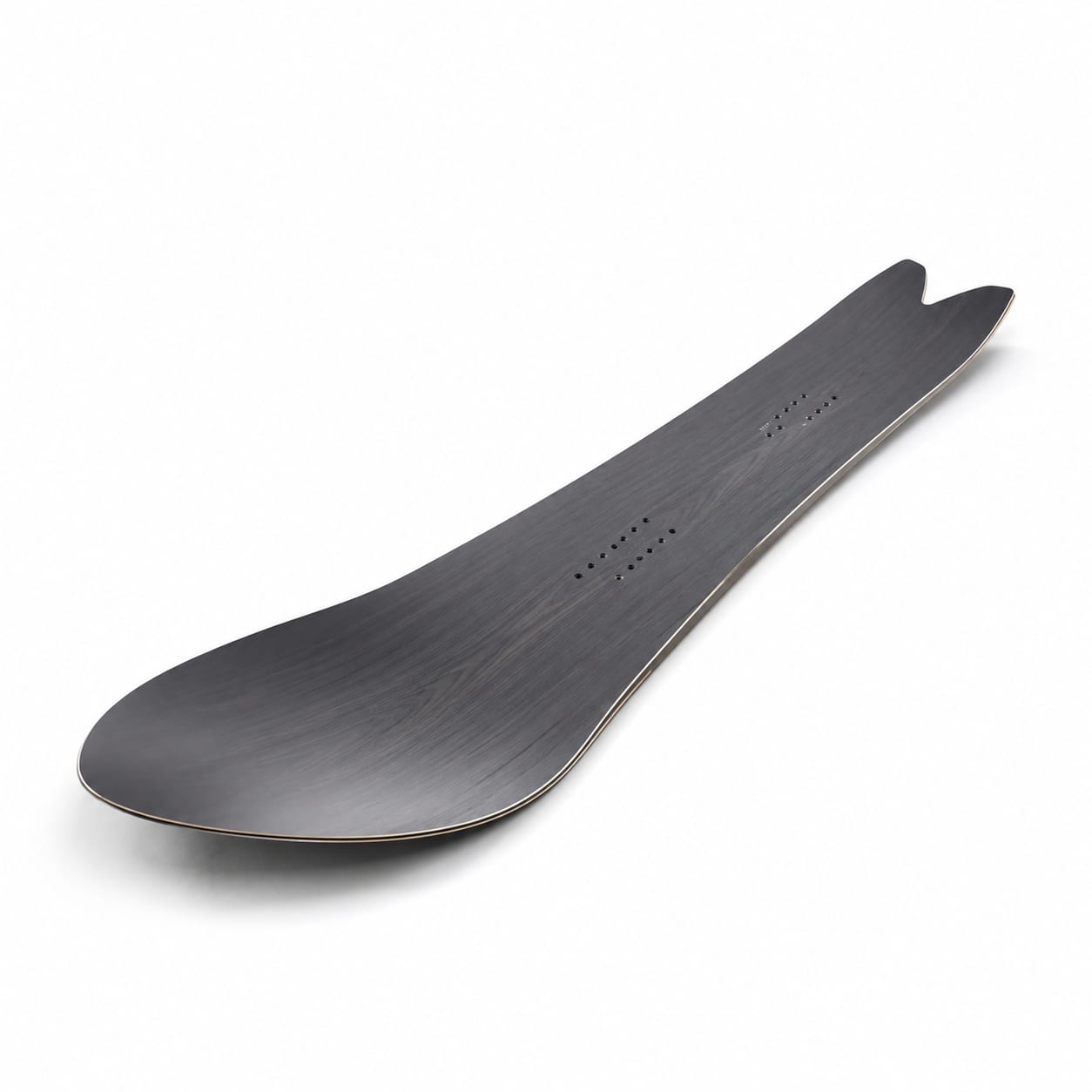
Pointed noses are most common for slicing through deep snow with minimal resistance. Swallow tails are the iconic powder shape, allowing the tail to sink and creating a natural pivot point for surfy turns. Forked tails offer a less extreme version of the same concept.
Compared to other types
Powder boards are the only category where swallow tails and forked tails are common. Freestyle boards use blunt shapes, all-mountain boards use pointed or slightly rounded shapes. The swallow tail is the defining aesthetic of dedicated powder boards.
Why it matters: The nose shape affects how the board displaces snow—a pointed nose parts snow efficiently and reduces spray in your face. The tail shape affects how the board finishes turns: swallow tails create a loose, slashy feel and enhance float by reducing tail surface area, while standard tails offer more grip and drive out of turns.
What it means
The difference between the nose width and tail width of the board, measured in millimeters. Greater taper enhances powder float.
Typical for this type
8–30 mm
Most common pick: 15 mm
In practice
Taper is the hallmark dimension of powder boards. Moderate taper (8–12mm) provides noticeable float improvement while maintaining reasonable hardpack performance. Aggressive taper (15–20mm) delivers exceptional float for deep days. Extreme taper (20mm+) is for bottomless powder specialists only.
Compared to other types
Powder boards have dramatically more taper than any other category. Freestyle and park boards have 0mm, all-mountain boards typically 0–5mm, and freeride boards 3–10mm. Powder boards start where other categories stop, making taper the clearest differentiator.
Why it matters: Taper is arguably the most important spec for powder performance—more impactful than length, width, or rocker alone. It creates the differential that makes the tail sink and nose rise. However, every millimeter of taper reduces hardpack performance and switch capability, so choosing the right amount depends on how deep your typical powder is and how much groomer performance you need.
Insert Pattern
Insert Pattern
What it means
The bolt hole pattern on the board for mounting bindings. Determines binding compatibility and stance adjustability.
Typical for this type
2x4, 4x4, Channel
In practice
Powder boards use standard insert patterns with 2x4 being the most common for its fine stance width adjustment. The Channel system is found on Burton powder boards and offers infinite micro-adjustment, which is useful for finding the optimal setback position on deep days.
Compared to other types
Insert patterns are consistent across categories, but the ability to adjust stance setback matters more on powder boards than any other type. The Channel system is particularly valued here for its micro-adjustability.
Why it matters: Stance positioning is especially important on powder boards because small adjustments to setback dramatically affect float and handling. A 2x4 or Channel system allows you to fine-tune your position—moving back a centimeter on a deep day can make a noticeable difference in float.