Kitvore.com

Kitvore.com

Specs that matter. Gear that fits.

Road Bike · Subcategory

Touring Road Bike

A road bike built for loaded long-distance travel with relaxed geometry, generous tire clearance, and extensive mounting points for racks and fenders.

Touring road bikes are the pack mules of the cycling world — designed to carry you and your gear across continents in comfort and reliability. With stable handling, durable frames, low gearing for loaded climbs, and mounting points for racks, fenders, and bottles, they prioritize function over speed. Whether you're crossing a country or a continent, a touring bike is your self-sufficient travel companion.

$800 – $6000mid tierintermediateadvancedexpert

Best known for

Long-distance loaded touring and bikepackingExtensive rack and fender mounting pointsStable, confidence-inspiring handling under loadDurability and field-serviceability in remote areasComfortable upright geometry for all-day riding
Touring Road Bike

Guide

Detailed overview

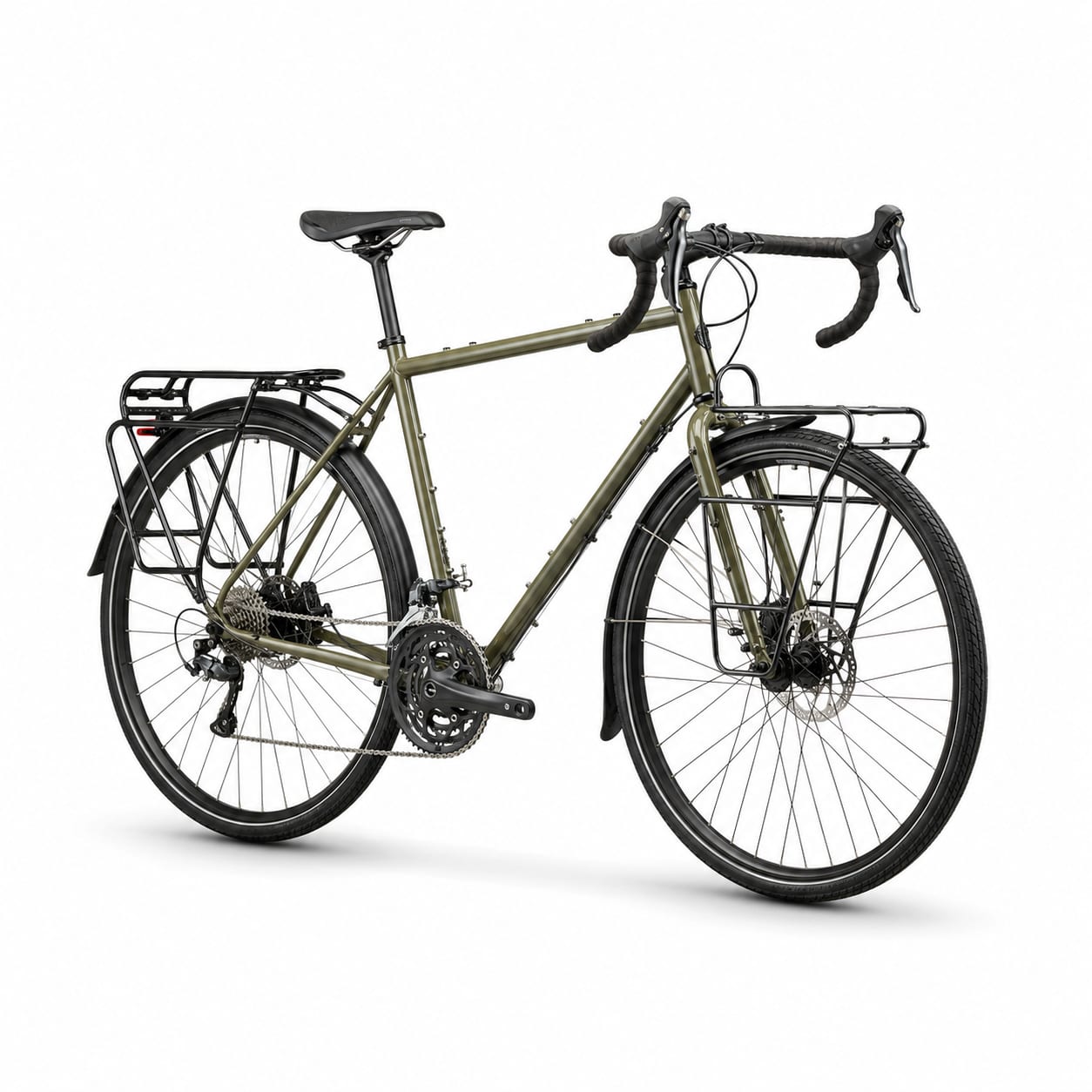
A touring road bike is purpose-built for self-supported long-distance travel with cargo. Unlike other road bikes that prioritize speed or light weight, touring bikes are engineered around reliability, comfort under load, and practical utility. They feature relaxed geometry with a high stack and short reach for an upright riding position that reduces fatigue over consecutive long days in the saddle. The wheelbase is extended through longer chainstays, which not only improves straight-line stability — especially important when carrying panniers — but also provides heel clearance for rear rack-mounted bags. Frame materials lean toward steel and titanium for their durability, fatigue resistance, and in the case of steel, field-repairability by any welder worldwide. Aluminum touring frames also exist at accessible price points. Carbon fiber is rare in this category due to concerns about impact damage and repair difficulty in remote locations. Touring bikes are distinguished by their mounting points: multiple water bottle cage mounts (often three on the main triangle), rear rack mounts, front rack mounts (on the fork), fender eyelets, and sometimes additional mounts on the fork legs for anything cages or extra bottles. Tire clearance is generous, typically 35mm or more, allowing riders to run plush tires that absorb road vibration and handle rough or unpaved sections encountered on tour. Drivetrains feature lower gearing than standard road bikes, with compact chainrings and wide-range cassettes to handle steep climbs while loaded with gear. Many touring bikes use bar-end shifters or friction shifters for their simplicity and reliability in remote areas, though modern options with Shimano 105 or GRX groupsets are increasingly popular. Hydraulic disc brakes are now standard on most new touring bikes for their consistent stopping power with heavy loads and in wet conditions, though some traditionalists still prefer mechanical disc or even rim brakes for ease of field repair.

Touring road bikes occupy a unique niche in the cycling world — they are machines designed not for speed, but for journey. Where a race bike asks how fast you can go, a touring bike asks how far you can go, and how reliably you can get there. This philosophy shapes every aspect of the design, from the relaxed geometry that keeps you comfortable through eight-hour riding days to the reinforced frame joints that withstand the constant vibration of loaded travel on rough roads.

The geometry of a touring bike is its defining characteristic. Stack heights run high and reach runs short, producing an upright riding position that might look inefficient to a racer but is a lifesaver on day 45 of a cross-continental tour. The head tube angle is slacker than most road bikes, and the fork trail is increased, both contributing to stable, predictable handling that resists the twitchiness that loaded panniers can introduce. Chainstays are notably longer — often 430mm or more — providing the heel clearance needed for rear panniers and the stable wheelbase that makes a loaded bike feel planted at speed and predictable in crosswinds.

Frame material choice in touring bikes is deeply practical. Steel remains the traditional favorite, not because it's the lightest or most technologically advanced, but because it offers the best combination of ride quality, durability, and repairability. A cracked steel frame can be welded by a mechanic in virtually any town on earth; the same cannot be said for carbon fiber or even aluminum. Titanium has gained popularity as a premium touring material, offering steel's ride quality and repairability with lower weight and zero corrosion concerns. Aluminum touring frames provide excellent value and are perfectly capable, though they transmit more road vibration than steel or titanium.

The component selection on touring bikes reflects the priority of reliability over performance. Drivetrains tend toward lower gearing — a typical touring setup might use a 48/32 crankset with an 11-34 cassette, providing the low gears needed to climb mountain passes with 20+ kg of gear. Brake systems have evolved from cantilevers to mechanical discs to hydraulic discs, with each step improving stopping power under load. Wheels are built with higher spoke counts (32 or 36) for durability and serviceability — a broken spoke in the middle of nowhere is a touring rider's nightmare, and standard spoke patterns mean replacements are available anywhere.

Perhaps the most important feature of a touring bike is also the most overlooked: mounting points. A proper touring frame will have braze-ons for front and rear racks, fender mounts, triple water bottle cage mounts on the main triangle, and often additional mounts on the fork legs and under the down tube. These aren't luxuries — they're the infrastructure that makes self-supported travel possible. Without them, you're limited to frame bags and seat packs, which work for bikepacking but can't match the carrying capacity and organization of a proper rack-and-pannier setup for extended tours.

Quick facts

Primary purpose
Loaded long-distance bicycle touring with cargo capacity
Popular brands
SurlyTrekKonaSalsaThornRivendell
Typical terrain
Paved roadsWell-maintained gravelLong-distance routes

What makes it different

Triple crankset or wide-range gearing; Long chainstays for pannier clearance; Steel or titanium frame preference; Hub generator compatibility

Recommended ranges

How this type usually specs out

Each spec is explained in plain language, then we show what buyers usually look for on this type.

Bike Type / Category

Road Bike Category

What it means

The intended use-case and design philosophy of the road bike, which determines its geometry, tube shapes, and component selection.

Typical for this type

Endurance Or All Road

In practice

Touring road bikes align most closely with the endurance category due to their relaxed geometry and comfort focus, though they share the tire clearance and versatility of all-road bikes. They are a specialized subset that adds mounting points and touring-specific features.

Compared to other types

Unlike aero race or climbing bikes that prioritize speed and responsiveness, touring bikes share the endurance category's comfort-first approach but go further with mounting points, lower gearing, and reinforced construction for loaded travel.

Why it matters: The category designation reflects the fundamental design philosophy — touring bikes prioritize comfort, stability, and utility over speed or aerodynamics, which aligns with endurance and all-road categories rather than race-oriented ones.

Frame Material

Frame Material

What it means

The primary material used in frame construction, which determines weight, stiffness, ride quality, durability, and cost.

Typical for this type

Steel, Titanium, Or Aluminum

In practice

Steel is the traditional and most popular choice for touring bikes due to its excellent ride quality, durability, fatigue resistance, and most importantly, field-repairability. Titanium offers similar benefits with lower weight and zero corrosion at a premium price. Aluminum provides a budget-friendly option with good durability. Carbon fiber is rare in this category.

Compared to other types

While carbon fiber dominates race and performance road categories, touring bikes favor steel and titanium for their durability and repairability. This is the opposite priority from climbing bikes where minimum weight is the goal.

Why it matters: On a multi-week or multi-month tour, frame reliability and serviceability are paramount. A steel frame can be welded by any mechanic worldwide, while carbon fiber damage typically ends a tour. The material also affects ride quality over long days — steel and titanium's natural compliance reduces fatigue.

Frame Size

Frame Size

What it means

The nominal size designation of the frame, typically based on seat tube length or a general sizing system, which determines overall bike fit.

Typical for this type

Choose Based On Height And Inseam; Touring Bikes Often Benefit From Sizing Up Slightly For Stability

Most common pick: Varies By Rider Height

In practice

Frame sizing follows standard road bike conventions, but touring riders sometimes prefer a slightly larger frame for the additional stability and more upright position it provides. Always verify with stack and reach measurements.

Compared to other types

Touring bikes may be sized slightly larger than race bikes for the same rider, prioritizing stability and comfort over the compact, agile feel preferred in racing.

Why it matters: A properly sized touring bike is critical because you'll spend long consecutive days in the saddle. A frame that's too small creates excessive reach and back pain; one that's too large reduces control, especially with loaded panniers.

Stack

Stack Height

What it means

The vertical distance from the center of the bottom bracket to the top of the head tube. Determines how upright or low the rider sits on the bike.

Typical for this type

560–620mm depending on size

Most common pick: 580mm (size 56)

In practice

Touring bikes have among the highest stack heights in the road bike category, producing a very upright riding position that reduces strain on the neck, shoulders, and lower back during long days in the saddle.

Compared to other types

Touring bike stack heights are typically 20–40mm higher than race bikes and 10–20mm higher than standard endurance bikes in the same nominal size, reflecting the maximum comfort priority.

Why it matters: High stack is essential for touring comfort. When riding 6–10 hours daily for weeks on end, an aggressive low position becomes unsustainable. The upright posture also improves visibility for navigation and traffic awareness.

Reach

Reach

What it means

The horizontal distance from the center of the bottom bracket to the top of the head tube. Determines how stretched out the rider is on the bike.

Typical for this type

360–385mm depending on size

Most common pick: 370mm (size 56)

In practice

Touring bikes have shorter reach values, producing a compact, upright cockpit that reduces strain on the hands, wrists, shoulders, and neck. The shorter reach also makes it easier to sit up and look around for navigation.

Compared to other types

Touring bike reach is typically 10–20mm shorter than race bikes in the same size, similar to or slightly shorter than endurance bikes, prioritizing comfort over aerodynamic efficiency.

Why it matters: Short reach is critical for all-day comfort and for maintaining control when riding with a front load. A stretched-out position fatigues the upper body quickly and makes handling a loaded front end more difficult.

Stack/Reach Ratio

Stack-to-Reach Ratio

What it means

The ratio of stack height to reach, indicating the overall riding position character independent of frame size. Higher ratios indicate more upright, endurance-oriented geometry.

Typical for this type

1.50–1.65

Most common pick: 1.55+

In practice

Touring bikes have the highest stack-to-reach ratios in the road bike family, typically 1.55 or above. This produces the most upright riding position, which is ideal for long-distance comfort but sacrifices aerodynamic efficiency at higher speeds.

Compared to other types

Race bikes typically range from 1.30–1.45, endurance bikes from 1.45–1.55. Touring bikes at 1.55+ are the most upright road bikes, trading all aerodynamic advantage for sustained comfort and load-handling stability.

Why it matters: A high stack-to-reach ratio is the defining geometry characteristic of a touring bike. It ensures the rider sits upright enough to ride comfortably for 8+ hours daily, sometimes for months. This ratio makes touring bikes feel stable and relaxed rather than twitchy or aggressive.

Weight

Complete Bike Weight

What it means

The total weight of the complete bicycle without pedals, bottles, or accessories. Affects climbing speed, acceleration, and handling.

Typical for this type

9.5–12.0kg

Most common pick: 10.5kg

In practice

Touring bikes are the heaviest road bikes due to their reinforced frames, mounting hardware, longer wheelbases, heavy-duty wheels, and durable components. Steel frames typically result in complete bikes around 10.5–12kg, while titanium and aluminum builds can be slightly lighter.

Compared to other types

Touring bikes are typically 2–4kg heavier than endurance bikes and 3–5kg heavier than climbing bikes. This weight comes from reinforced construction, extra mounting hardware, and durable components chosen for reliability over light weight.

Why it matters: Weight is a secondary concern for touring bikes — durability, comfort, and carrying capacity matter far more. The bike will be carrying 15–30kg of gear anyway, so a 1kg difference in frame weight is negligible in context. However, extremely heavy bikes make unloaded riding and climbing less enjoyable.

Groupset / Drivetrain Level

Groupset Tier

What it means

The tier and brand of the drivetrain component group, which determines shifting performance, weight, durability, and features like electronic shifting.

Typical for this type

Shimano Tiagra/Sora Through Shimano 105; SRAM Rival Or Apex

Most common pick: Shimano 105

In practice

Touring bikes typically use mid-range groupsets like Shimano 105, Tiagra, or SRAM Rival/Apex. These offer the best balance of reliability, ease of maintenance, and value. Bar-end shifters are also popular among traditional touring bikes for their simplicity and field-serviceability.

Compared to other types

While race bikes use top-tier groupsets for maximum performance, touring bikes prioritize mid-range options for their durability, parts availability, and value. The performance difference is irrelevant at touring speeds.

Why it matters: On tour, groupset reliability is critical — a broken derailleur in a remote area can end a trip. Mid-range groupsets offer excellent durability and are easier to find replacement parts for worldwide. Premium groupsets like Dura-Ace or Red offer no practical advantage for touring and are harder to source parts for.

Speed / Number of Gears

Number of Gears

What it means

The total number of gear combinations available, determined by the number of chainrings multiplied by the number of cassette sprockets.

Typical for this type

2x11 or 2x12; 3x10 for traditional touring setups

In practice

2x11 is the most common current touring setup, offering a wide gear range with reasonable steps. 2x12 is becoming more common on newer models. Some traditional touring bikes still use 3x10 setups for the widest possible gear range, especially for heavily loaded touring in mountainous terrain.

Compared to other types

Touring bikes often use sub-compact chainrings (48/32 or 46/30) paired with wide-range cassettes (11-34 or 11-36), unlike race bikes that use standard or compact cranks with tighter cassettes. Some touring setups use triple chainrings, which are virtually extinct in other road categories.

Why it matters: Touring requires lower gears than other road riding due to the combined weight of rider and gear. A typical loaded touring setup needs gears below 1:1 ratio (e.g., 28x32 or lower) to climb steep passes with panniers. The gear range matters more than the number of gears.

Brake Type

Brake Type

What it means

The braking system type, which affects stopping power, modulation, tire clearance, weight, and maintenance requirements.

Typical for this type

Hydraulic Disc Preferred; Mechanical Disc Acceptable For Budget Or Field-Serviceability Priority

Most common pick: Hydraulic Disc

In practice

Hydraulic disc brakes are now standard on most new touring bikes, providing consistent stopping power with heavy loads and in wet conditions. Mechanical disc brakes remain popular among riders who prioritize field-serviceability, as they can be adjusted and repaired with basic tools anywhere.

Compared to other types

Touring bikes were slower to adopt hydraulic discs than race bikes due to concerns about field repairability, but the performance benefits with heavy loads have made them standard. Mechanical discs remain a viable option for remote-area touring where hydraulic service may be unavailable.

Why it matters: Stopping a loaded touring bike (rider + bike + 20-30kg of gear = 100+ kg total) requires serious braking power, especially on long mountain descents. Disc brakes provide this power consistently in all weather conditions, which is critical for safety on tour.

Max Tire Width

Maximum Tire Clearance

What it means

The widest tire the frame and fork can accommodate, which determines versatility for different road surfaces and conditions.

Typical for this type

35mm minimum; 38–45mm ideal

Most common pick: 38mm

In practice

Touring bikes offer generous tire clearance, typically 38mm or more, allowing riders to run wide, plush tires that absorb road vibration and handle rough or unpaved surfaces encountered on tour. This clearance also accommodates tires with full fenders, which are essential for wet-weather touring.

Compared to other types

Touring bikes have tire clearance similar to all-road bikes and significantly more than race or endurance bikes. This clearance is necessary not just for comfort but for the practical reality that tours often encounter unpaved sections, and the bike must handle them safely with a load.

Why it matters: Wide tires at lower pressures are faster on rough roads due to reduced vibration losses, and they provide essential comfort for long days in the saddle. Clearance for tires with fenders is critical — touring in rain without fenders is miserable, and fenders require 4-5mm of additional clearance per side.

Wheel Size

Wheel Size

What it means

The nominal diameter of the wheels; determines tire availability, ride characteristics, and geometry constraints.

Typical for this type

700c standard; 650b for smaller frames or road-plus tire setups

In practice

700c is the standard wheel size for touring bikes, offering the widest tire availability and easiest replacement worldwide. 650b wheels are sometimes used on smaller frames or for road-plus setups with very wide tires (47-50mm).

Compared to other types

Touring bikes use the same 700c standard as other road bikes, but with higher spoke counts (32 or 36) and heavier-duty rims for durability under load. Wheel reliability is more important than weight or aerodynamics for touring.

Why it matters: On tour, tire and wheel availability matters — 700c tires and tubes are available in bike shops worldwide. 650b options are much more limited, especially in remote areas. This practical consideration often outweighs any performance benefit of 650b.

Head Tube Angle

Head Tube Angle

What it means

The angle of the head tube relative to horizontal; affects steering speed, stability, and front-end feel.

Typical for this type

71.0–72.5°

Most common pick: 72.0°

In practice

Touring bikes use slacker head tube angles than race or endurance bikes, typically 71–72.5°. This contributes to stable, predictable steering that resists the twitchiness that loaded panniers can introduce, especially at speed or in crosswinds.

Compared to other types

Touring bikes have the slackest head tube angles in the road bike family, typically 1–2° slacker than race bikes. This is a deliberate trade of quick steering response for stability under load.

Why it matters: Stable handling is critical for touring safety, especially with a front load that can make the bike feel vague or unpredictable. The slacker head angle, combined with increased fork trail, produces steering that requires more input to initiate but holds a line more confidently — exactly what you want when descending a mountain pass with 20kg of gear.

Chainstay Length

Chainstay Length

What it means

The distance from the bottom bracket center to the rear axle; affects rear-end compliance, traction, and wheelbase.

Typical for this type

420–445mm

Most common pick: 425mm

In practice

Touring bikes have the longest chainstays in the road bike category, typically 420–445mm. The extended rear triangle provides heel clearance for rear panniers, improves stability with a load, and creates a longer wheelbase that smooths out road imperfections.

Compared to other types

Touring bike chainstays are 15–40mm longer than race bikes (405–410mm) and 10–20mm longer than most endurance bikes (415–420mm). This is one of the most distinctive geometric differences in a touring frame.

Why it matters: Long chainstays are essential for touring bikes — without them, a rider's heels will strike rear panniers, making the bike unrideable with a loaded rack. The additional length also contributes to stable, predictable handling under load and provides more compliance from the rear triangle.

BB Drop

Bottom Bracket Drop

What it means

The vertical distance the bottom bracket sits below the wheel axle line; affects cornering clearance and center of gravity.

Typical for this type

68–72mm

Most common pick: 70mm

In practice

Touring bikes use a moderate bottom bracket drop, typically 68–72mm. This balances a low center of gravity for stability with adequate pedal clearance for cornering and riding on rough terrain with loaded panniers.

Compared to other types

Touring bikes use similar BB drop to endurance bikes but slightly less than some race bikes that optimize for low center of gravity. The priority is balanced — enough drop for stability but enough clearance for varied terrain.

Why it matters: A lower center of gravity improves stability with a load, but too much drop risks pedal strikes on rough roads or when cornering with the bike leaning under pannier weight. Touring bikes need enough clearance to handle varied terrain while maintaining stable loaded handling.

Aero Optimization

Aerodynamic Features

What it means

The degree and type of aerodynamic optimization in the frame and component design, which affects high-speed efficiency.

Typical for this type

Minimal Aero / Traditional

Most common pick: Minimal Aero

In practice

Touring bikes have essentially no aerodynamic optimization. Round or near-round tube profiles are standard, and there is no integration of cables or components. This is a deliberate choice — aero features add weight, complicate maintenance, and are irrelevant at touring speeds of 15–25 km/h.

Compared to other types

Touring bikes are the least aerodynamically optimized road bikes. While aero race bikes save 15-25 watts at 40km/h, a touring rider at 20km/h with panniers would save less than 5 watts — completely negligible compared to the weight and complexity costs.

Why it matters: Aerodynamic optimization is irrelevant for touring. At typical loaded touring speeds, aerodynamic drag is a minor factor compared to rolling resistance, gradient, and the weight of gear. Simple, round tube profiles are lighter, stronger, and easier to mount accessories to.

Seatpost Type

Seatpost Type

What it means

The seatpost design and integration level, which affects ride comfort, adjustability, and weight.

Typical for this type

Standard Round (27.2mm Preferred For Compliance)

Most common pick: Standard Round

In practice

Touring bikes universally use standard round seatposts, typically 27.2mm for compliance or 31.6mm for strength. This ensures maximum compatibility with replacement posts and saddle bags, and allows easy adjustment for different riders on shared tours.

Compared to other types

While aero race bikes use integrated seatposts for aerodynamic gains, touring bikes prioritize universal compatibility and serviceability. This is a clear example of the different design priorities between categories.

Why it matters: A standard round seatpost can be replaced anywhere in the world — a critical consideration for touring. Proprietary or integrated seatposts are impractical for touring because a broken seatpost in a remote area with no replacement available would end a tour. The 27.2mm diameter also provides natural compliance for comfort.

Evaluation

Strengths and trade-offs

Pros

What this type does best

Exceptional long-distance comfort

Critical

The upright geometry, generous tire clearance, and compliance-focused design allow riders to spend 8+ hours in the saddle day after day without the chronic pain that aggressive road bikes cause on long tours.

Massive carrying capacity

Critical

Extensive mounting points for front and rear racks, fenders, multiple water bottles, and accessory mounts enable self-supported touring with all the gear needed for days or weeks between resupply points.

Stable, predictable handling under load

High

The long wheelbase, slack head angle, and extended chainstays produce stable handling that remains confidence-inspiring even with 20+ kg of panniers, crosswinds, and rough road surfaces.

Field-serviceable and durable

High

Steel or titanium frames can be repaired by welders worldwide, standard components are available in bike shops globally, and the overall construction prioritizes durability over weight savings.

Versatile on varied surfaces

High

Wide tire clearance allows touring bikes to handle paved roads, chip seal, gravel, dirt tracks, and even light singletrack — essential for tours that inevitably encounter unexpected road conditions.

Low gearing for loaded climbing

High

Sub-compact chainrings and wide-range cassettes provide the low gears needed to climb mountain passes with heavy loads, something standard road bike gearing cannot do.

Fender compatibility for all-weather riding

Medium

Dedicated fender mounts with sufficient tire clearance for fenders make touring bikes practical for rain riding, which is inevitable on long tours.

Lifetime investment durability

Medium

A quality steel or titanium touring frame can last decades and tens of thousands of kilometers, making it a lifetime investment that outlasts multiple race bikes.

Cons

Trade-offs to be aware of

Heavy and slow compared to other road bikes

Moderate

Touring bikes weigh 2–5kg more than race or endurance bikes and the upright position creates significant aerodynamic drag. Unloaded riding feels sluggish compared to performance road bikes.

Not suitable for group rides or fast cycling

Moderate

The upright position, heavy weight, and stable (rather than responsive) handling make touring bikes poorly suited for fast group rides, club rides, or any riding where keeping up with road bikes is expected.

Limited performance on paved roads

Moderate

On smooth pavement without a load, a touring bike feels unnecessarily heavy, slow-handling, and inefficient compared to endurance or race bikes designed for that terrain.

Component availability for traditional setups

Minor

Some touring bikes use bar-end shifters, cantilever brakes, or other traditional components that are becoming harder to find as the industry moves toward integrated and electronic systems.

Storage and transport challenges

Minor

The long wheelbase and permanent rack/fender mounts make touring bikes more cumbersome to store, transport on car racks, and pack for air travel than standard road bikes.

Higher cost for durable construction

Minor

Quality touring bikes with steel or titanium frames and durable components often cost as much or more than carbon race bikes, with the expense going into durability rather than performance.

Best for

Surfaces & terrain

Paved roads with occasional rough sectionsChip seal and deteriorated pavementLight gravel and dirt roadsMountain passes and long climbsVariable and unpredictable road conditions

Riding conditions

Multi-day and multi-week toursAll-weather riding including rain and coldRemote areas with limited resupplyMixed-surface routesCrosswind-prone open terrain

Skill level

Intermediate riders planning their first tourExperienced touring cyclistsBikepackers transitioning to rack-and-pannier setupsLong-distance cyclists of all levels

Riding discipline

Self-supported touringRandonneuring and brevetsExpedition cyclingCommuting with heavy loadsSlow travel and bike-based exploration

Rider profile

Touring cyclists planning loaded multi-day tripsBike travelers crossing countries or continentsCommuters who carry heavy loads regularlyRiders who prioritize comfort and reliability over speedCyclists seeking a lifetime bike for varied riding

Not ideal for

Reasons

Too heavy and slow for keeping pace with road bikes on group ridesUpright position creates excessive aerodynamic drag at speeds above 30 km/hStable handling feels sluggish and unresponsive for aggressive ridingMounting hardware and rack eyelets add weight and complexity for riders who never use themA dedicated touring bike is overkill for riders who only occasionally do long rides without cargo

Surfaces & terrain

Smooth paved roads for fast training ridesTechnical singletrack or mountain bike trailsSteep, technical cyclocross courses

Skill level

Complete beginners who should start on a more versatile road bikeRiders focused on racing or fast group rides

Riding discipline

Road racing and criteriumsFast club rides and group trainingTime trialingHill climb competitionsTrack cycling

Compare

How it stacks up

This page

Touring Road Bike

Superior carrying capacity with rack and fender mounts, more stable handling under load, wider tire clearance for fenders, lower gearing for climbing with gear, and field-repairable frame options.

Alternative

Endurance Road Bike

Lighter weight, more responsive handling, faster on paved roads, more aerodynamic position, wider selection of models and price points, better for fast group rides.

Bottom line

Choose a touring bike if you plan to carry racks and panniers on multi-day trips. Choose an endurance bike if you want comfort for long day rides without the need for cargo capacity.

This page

Touring Road Bike

Dedicated rack and fender mounts for proper touring, more stable geometry for loaded handling, lower gearing for climbing with weight, and frame materials chosen for durability and repairability.

Alternative

All-Road Bike

Lighter weight, more versatile for mixed-surface riding without loads, sportier handling for enjoyable unloaded riding, often less expensive, better as an everyday road bike.

Bottom line

Choose a touring bike for dedicated loaded touring with racks. Choose an all-road bike for mixed-surface day rides and bikepacking with frame bags where rack mounts aren't needed.

This page

Touring Road Bike

Better carrying capacity with proper rack mounts, more stable handling under heavy loads, more comfortable upright position for all-day riding, and typically more durable wheel builds.

Alternative

Gravel Bike

Better off-road capability on rough gravel and dirt, lighter and more responsive handling, more sporty riding experience, wider tire clearance for aggressive off-road tires, better for gravel racing.

Bottom line

Choose a touring bike for paved and light gravel touring with heavy loads. Choose a gravel bike for off-road-focused riding and bikepacking on rougher surfaces where carrying capacity needs are moderate.

This page

Touring Road Bike

Vastly more comfortable for long days, can carry all touring gear, stable and safe with loads, durable and repairable, practical for real-world riding conditions.

Alternative

Aero / Race Road Bike

Dramatically faster on flat paved roads, much lighter, more responsive and exciting handling, aerodynamic efficiency, designed for competitive performance.

Bottom line

These bikes serve completely different purposes. A touring bike is for travel and self-sufficiency; a race bike is for speed and competition. They are not interchangeable — choose based on your primary riding goal.

Shopping

Buying tips

  • 1

    Verify mounting points before buying — count the bottle cage mounts, check for front and rear rack eyelets, and confirm fender mounts. A touring bike without proper mounting points defeats the purpose.

  • 2

    Choose frame material based on your tour plans: steel for maximum repairability worldwide, titanium for durability with lower weight, aluminum for budget-conscious touring. Avoid carbon fiber for remote-area touring.

  • 3

    Prioritize tire clearance of at least 38mm with fenders — this gives you the flexibility to run 32-35mm tires with full fenders or wider tires without fenders for rougher routes.

  • 4

    Test the gearing by calculating your lowest gear ratio (chainring teeth ÷ cassette cog teeth). For loaded touring, you want a ratio below 1:1 (e.g., 28×32 = 0.88). Lower is better for mountain passes with gear.

  • 5

    Consider bar-end or downtube shifters for remote-area touring — they're simpler, more durable, and can be run in friction mode if indexing fails. For most riders, standard STI/Ergo levers are fine.

  • 6

    Budget for a wheel upgrade or at least verify spoke count — 32 or 36 spokes with brass nipples and a quality rim is the standard for touring. Anything less is a liability under heavy loads on rough roads.

  • 7

    Don't overlook the saddle — you'll spend thousands of kilometers in it. Budget for a professional bike fit and a quality saddle that works for your anatomy.

  • 8

    Buy from a shop that understands touring — they'll help with rack and fender installation, gear ratio optimization, and accessory selection that a standard road bike shop may not prioritize.

Care

Maintenance notes

  • Inspect frame and fork for cracks or damage after any significant impact — steel and titanium show warning signs before failing, while aluminum can crack suddenly.
  • Check spoke tension and wheel true regularly, especially after rough roads. Broken spokes are the most common touring mechanical issue — carry 2-3 spare spokes and a spoke wrench.
  • Clean and lubricate the chain frequently on tour — loaded bikes put more stress on drivetrains, and dusty or wet conditions accelerate wear. Replace chains before they're worn enough to damage the cassette.
  • Carry spare brake pads, cables, and housing — disc brake pads wear faster with heavy loads, and cable replacement is the most common brake service need on mechanical disc systems.
  • Re-grease headset and hub bearings periodically, especially after riding in heavy rain or stream crossings. Water ingress is the primary cause of bearing failure on tour.
  • Check rack bolts and mounting hardware for tightness regularly — vibration from loaded touring loosens fasteners over time. Consider Loctite on critical bolts.
  • Protect the frame from pannier rub with frame tape or protective pads at contact points — repeated rubbing from loaded panniers can wear through paint and even frame material over thousands of kilometers.

Progression

Skill development path

Touring road bikes are accessible to intermediate riders and above. Beginners should start with shorter overnight trips (1-2 nights) to learn packing, bike handling with loads, and basic touring logistics before attempting longer tours. The key skills to develop are: loading a bike symmetrically and keeping heavy items low, riding efficiently with a load (smooth pedaling, early braking, wider turns), basic mechanical skills (fixing flats, adjusting brakes, replacing cables), and route planning with resupply points. Most riders can comfortably transition to touring after 6-12 months of regular road cycling. Advanced touring skills include dirt-road touring, expedition cycling in developing countries, and winter touring — each requiring progressively more experience and specialized equipment knowledge.

FAQ

Common questions

Each question has a dedicated page with a full answer and links to the buying guide.

Can I use a touring bike for regular road riding when I'm not touring?

Yes, but it won't be as enjoyable as a standard road bike. Touring bikes are heavier, less aerodynamic, and handle more slowly than road bikes. For occasional unloaded rides, remove the racks and fenders and put on lighter tires — this makes a significant difference. Many touring bike owners also have a lighter road bike for day rides and use the touring bike exclusively for its intended purpose.

Do I really need a dedicated touring bike, or can I tour on an endurance or gravel bike?

It depends on your touring style. For bikepacking with frame bags and seat packs on mixed surfaces, a gravel or all-road bike works well. For traditional rack-and-pannier touring with heavy loads on paved roads, a dedicated touring bike is significantly better due to its rack mounts, stable loaded handling, lower gearing, and longer chainstays for heel clearance. If you plan to do more than one or two tours, a dedicated touring bike is worth the investment.

Steel vs. titanium vs. aluminum for a touring frame — which should I choose?

Steel is the traditional choice offering the best ride quality, repairability (any welder can fix it), and reasonable cost. Titanium provides similar ride quality with lower weight and zero corrosion, but at a premium price and with fewer repair options. Aluminum is the budget choice — durable and stiff but with harsher ride quality and no repair option for cracks. For most touring cyclists, steel offers the best balance of practicality, comfort, and value.

What gearing do I need for loaded touring?

For loaded touring, you need lower gears than standard road bikes. A minimum low gear of 28×32 (0.88 ratio) is acceptable for moderate terrain, but 26×34 (0.76) or lower is better for mountainous tours. Sub-compact cranksets (48/32 or 46/30) paired with wide-range cassettes (11-34 or 11-36) are ideal. If your route includes steep climbs, consider a triple crankset or MTB derailleur with an even wider cassette. It's always better to have lower gears you don't need than to need lower gears you don't have.