Material Type
Material Type
What it means
The primary fabric composition of the base layer, which determines moisture management, odor resistance, warmth, durability, and care requirements.
Typical for this type
Merino Wool Or Wool Blend
In practice
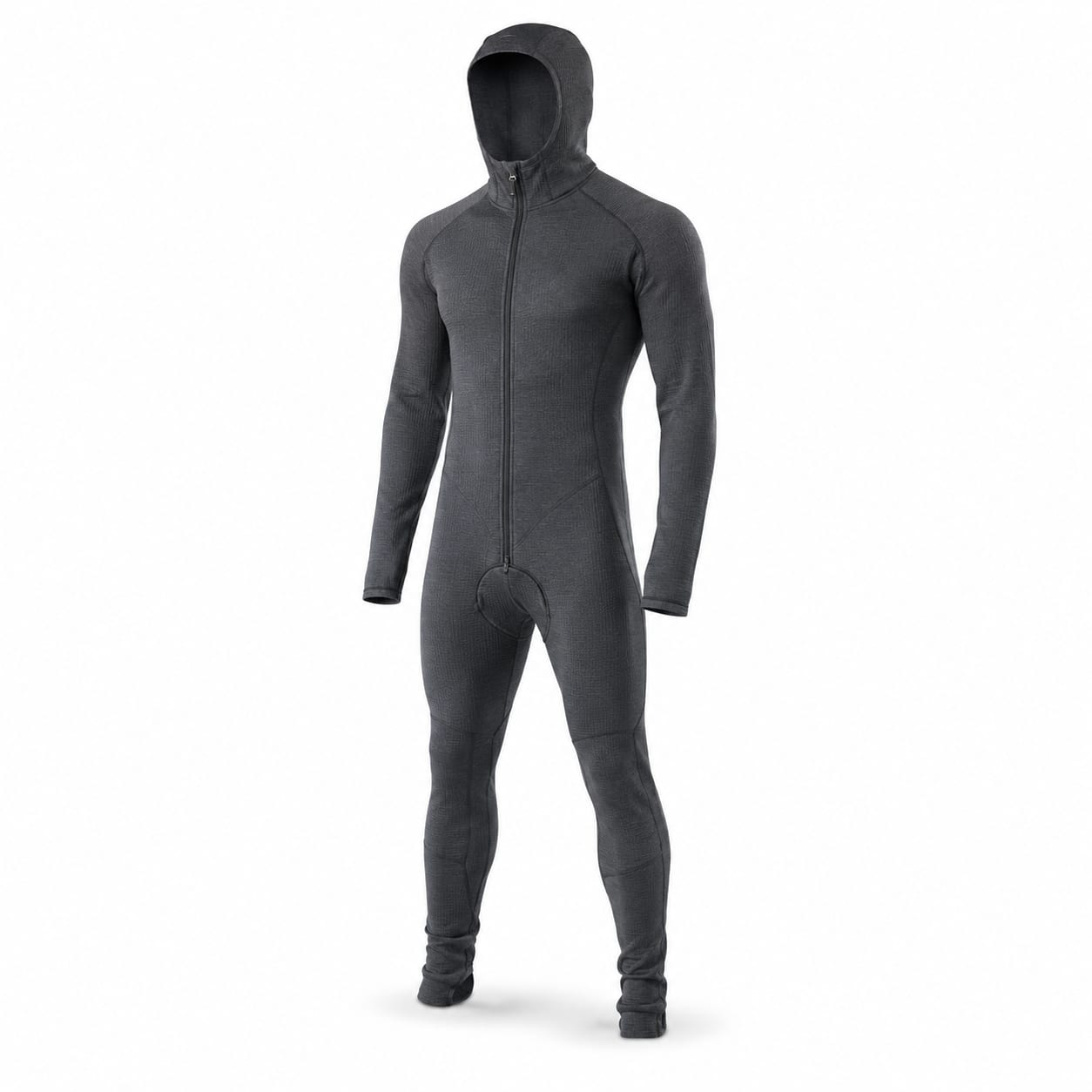
One-piece suits are most commonly found in merino wool or wool-synthetic blends. The blend is popular because the added synthetic fibers improve durability and stretch—critical in a garment that experiences stress across the entire body. Pure merino options exist but may bag out in high-stress areas like the knees and seat.
Compared to other types
Compared to two-piece sets where you can mix materials (e.g., synthetic top, merino bottom), one-piece suits commit to a single material for the entire body. Wool blends are the pragmatic choice for balancing odor resistance with the durability needed in a full-body garment.
Why it matters: Material choice in a one-piece suit is especially important because you cannot swap out just the top or bottom if one area underperforms. The material must work well across your entire body, handling both high-sweat zones (underarms, back) and cold-sensitive zones (kidneys, lower back).
What it means
The fabric weight category, which correlates with warmth, bulk, and intended temperature range. Measured in grams per square meter (g/m²) of fabric.
Typical for this type
Lightweight to midweight (130–260 g/m²)
In practice
Most one-piece suits fall in the midweight range (180–260 g/m²) because the primary use case is cold-weather skiing where the gap-elimination benefit matters most. Lightweight options exist for milder conditions but are less common since the one-piece advantage is less critical when it is warm.
Compared to other types
One-piece suits tend to run warmer than equivalent-weight two-piece sets because there are no gaps for heat to escape. If you normally wear a lightweight two-piece set, you may find a lightweight one-piece suit provides comparable warmth to a midweight two-piece.
Why it matters: Because a one-piece suit covers your entire body, the weight class has a magnified effect on overall warmth and breathability. A midweight one-piece suit provides significantly more total insulation than a midweight top alone, since there is no ventilation gap at the waist.
What it means
How closely the garment conforms to the body, affecting moisture wicking efficiency, layering compatibility, and freedom of movement.
Typical for this type
Slim (Form-Fitting)
In practice
A slim fit is essential for one-piece base layer suits. Because the garment spans the entire body, any excess fabric will bunch at the waist, hips, or crotch—areas where separate layers would normally overlap. The suit must be close to the skin everywhere to wick moisture effectively and layer cleanly under mid-layers.
Compared to other types
Fit is more critical for one-piece suits than for two-piece sets because there is no way to size the top and bottom independently. Riders with proportionally different upper and lower body measurements may find it harder to achieve a good fit in a one-piece.
Why it matters: Poor fit in a one-piece suit is more problematic than in separates because you cannot adjust one piece independently. A loose torso means the top portion sags, while tight hips restrict movement. Getting the right fit across your entire body is critical.
What it means
The neckline and design of the upper-body base layer, affecting ventilation, layering, and comfort.
Typical for this type
Zip Neck Half Or Crew Neck
In practice
Half-zip mock necks are the most common top style for one-piece suits because the front zip serves double duty: it provides the entry point for getting the suit on and off, and it offers adjustable ventilation during high-output skiing. Crew neck versions exist but require a separate entry system (usually a shoulder zip or rear zip).
Compared to other types
Unlike separate tops where the neckline is purely about ventilation and comfort, the top style on a one-piece suit is functionally tied to the garment's entry system. This makes half-zip designs more prevalent in one-piece suits than in separate tops.
Why it matters: The top style on a one-piece suit is also the entry/exit mechanism. A half-zip that extends low enough allows you to step into the suit and pull it up, then zip it closed. The zip must be long enough for easy entry but not so long that it compromises warmth at the neck.
What it means
The length and design of the lower-body base layer, affecting coverage, layering, and boot compatibility.
Typical for this type
Full Length (Ankle)
In practice
One-piece suits almost universally feature full-length bottoms that extend to the ankle. The entire point of the one-piece design is complete coverage, so 3/4 or short lengths would undermine the primary advantage. Stirrups under the foot are common to keep the legs anchored and prevent ride-up inside ski boots.
Compared to other types
While 3/4 length bottoms are popular in two-piece sets for boot compatibility, one-piece suits almost exclusively use full length because the connected design means the leg fabric is anchored from above and less likely to bunch inside the boot.
Why it matters: Full-length coverage ensures there is no gap between the bottom of the suit and your ski socks. The connection point at the ankle is critical—if the suit rides up inside your boot, it can cause discomfort and cold spots.
Moisture Wicking
Moisture Wicking
What it means
The garment's ability to pull perspiration away from the skin and spread it across the fabric surface for evaporation. Critical for staying dry and warm during active skiing.
Typical for this type
Good to Excellent
In practice
One-piece suits need effective moisture wicking across the entire body. Because the garment covers more surface area than any separate piece, sweat management is critical—there is no option to remove just the top if you overheat. Body-mapped construction with lighter zones under the arms and behind the knees helps manage moisture in high-sweat areas.
Compared to other types
One-piece suits have a moisture management disadvantage compared to two-piece sets because you cannot remove or adjust one piece independently. This makes body-mapped construction and zip ventilation more important in one-piece designs.
Why it matters: A one-piece suit that does not wick effectively creates a larger area of damp fabric against your skin compared to a separate top that could be removed or unzipped. This makes moisture wicking arguably more important in a one-piece than in separates.
Odor Resistance
Odor Resistance
What it means
The garment's ability to resist bacterial growth and associated odors over multiple wears. Affects how many days you can wear the base layer between washes on multi-day trips.
Typical for this type
Good to Excellent (3+ Days)
In practice
Merino wool and wool-blend one-piece suits offer good to excellent odor resistance, which is valuable because the larger garment takes longer to dry after washing. For multi-day trips, the odor resistance of a merino-based one-piece suit means you can wear it for several days without offending lodge-mates.
Compared to other types
Odor resistance matters more for one-piece suits on multi-day trips because you cannot pack a spare top while reusing the bottom—you need to wash or replace the entire suit. Merino or merino-blend suits are strongly recommended for trip use.
Why it matters: Because a one-piece suit is a single garment covering your entire body, it accumulates odor across a larger surface area. Strong odor resistance is more valuable in a one-piece than in separates, where you could swap out just the top.
Seam Construction
Seam Construction
What it means
The type and placement of seams, which affect chafing potential, durability, and comfort under layers and gear.
Typical for this type
Flatlock Or Seamless
In practice
Flatlock seams are the standard for one-piece base layer suits because they lie flat under layers and reduce chafing at the many seam junctions inherent in a full-body garment. Seamless construction is available in premium models and eliminates chafing entirely, which is especially beneficial at the crotch and underarm intersections.
Compared to other types
Seam construction quality matters more in one-piece suits because there are more seams and intersections. A poorly constructed one-piece can chafe at the crotch, underarms, and shoulder areas where multiple seams converge.
Why it matters: A one-piece suit has more seam junctions than separates—particularly at the crotch, underarms, and where the torso meets the legs. These intersection points are where seams can bunch and chafe, making flatlock or seamless construction more important than in two-piece sets.
What it means
The garment's ability to stretch and recover, affecting freedom of movement and long-term fit retention.
Typical for this type
Four Way (4-Way Stretch)
In practice
4-way stretch is strongly recommended for one-piece base layer suits because the garment must accommodate movement across the entire body without restriction. The connected design means that bending at the waist or knees creates pull across multiple body zones simultaneously—unlike separates where each piece moves independently.
Compared to other types
Stretch is more critical in one-piece suits than in separates because the connected design means movement in one area creates tension across the entire garment. A two-piece set allows each piece to move independently, reducing the need for full-body stretch.
Why it matters: Without adequate stretch, a one-piece suit can feel restrictive during dynamic skiing movements. When you bend your knees in a tuck, the fabric must stretch across your back, hips, and knees simultaneously. 4-way stretch with elastane (typically 3–5%) provides the necessary give.
What it means
The intended gender fit of the garment, which affects cut, proportions, and anatomical features.
Typical for this type
Mens Or Womens (Avoid Unisex)
Most common pick: Gender-Specific (Mens Or Womens)
In practice
Gender-specific fits are especially important for one-piece suits because the garment must fit properly across the entire body simultaneously. A unisex one-piece will almost certainly fit poorly somewhere—the shoulders, the torso length, the hip width, or the crotch depth. Women's models account for narrower shoulders, shorter torso, wider hips, and different crotch construction including drop-seat designs.
Compared to other types
Gender-specific fit matters more for one-piece suits than for separates because you cannot mix and match sizes. A woman who wears a men's separate top and women's separate bottom has no equivalent option in a one-piece suit.
Why it matters: In a one-piece suit, there is no way to compensate for a poor fit in one area by adjusting another piece. If the hips are too narrow, the entire suit feels restrictive. If the torso is too long, the crotch sags. Gender-specific patterning is essential for comfort and performance.
Warmth Rating
Warmth Rating
What it means
The perceived warmth level of the garment, combining material, weight, and construction into a single comparative metric.
Typical for this type
Moderate to High
In practice
One-piece suits typically rate high for warmth because the gap-free design inherently retains more heat than separates. Even a moderate-weight one-piece suit often feels warmer than a comparable two-piece set because there is no ventilation at the waist. This makes them ideal for cold-weather skiing but potentially too warm for mild spring days.
Compared to other types
A one-piece suit in moderate warmth often provides equivalent or greater warmth than a high-warmth two-piece set because there are no gaps for heat loss. Consider sizing down in warmth rating compared to what you would choose in separates.
Why it matters: The warmth advantage of a one-piece suit is its primary selling point, but it can also be a drawback if you overheat easily. Because you cannot remove just the top to cool down, you are committed to the warmth level of the full suit. Zip ventilation at the neck is essential for temperature regulation.
What it means
Whether the top includes thumbholes at the cuff to keep sleeves in place and provide hand coverage during layering.
Typical for this type
True (Yes)
In practice
Thumbholes are more common on one-piece suits than on separate tops because they help anchor the sleeves during the full-body entry process. When stepping into and pulling up a one-piece suit, sleeves without thumbholes tend to ride up and require readjustment. Thumbholes keep the sleeves in place and add wrist warmth.
Compared to other types
Thumbholes are more valuable in one-piece suits than in separate tops because sleeve adjustment is more difficult when the sleeve is connected to a full-body garment. The anchoring benefit during dressing is unique to one-piece designs.
Why it matters: Thumbholes prevent sleeve ride-up both during dressing and during active skiing. In a one-piece suit, adjusting a sleeve that has ridden up requires reaching through layers, which is more cumbersome than with a separate top. Thumbholes eliminate this issue.
Gusseted Crotch
Gusseted Crotch
What it means
Whether the bottom base layer includes a diamond or triangular fabric panel at the crotch for enhanced mobility and reduced seam stress.
Typical for this type
True (Yes)
In practice
A gusseted crotch is highly recommended for one-piece base layer suits because the connected design creates more fabric stress at the crotch during bending and sitting movements. The gusset eliminates the 4-seam intersection point, reduces chafing, and provides greater range of motion—especially important when the suit is under tension from the connected torso.
Compared to other types
Gusseted crotches are more important in one-piece suits than in separate bottoms because the connected torso creates additional pull on the crotch area during movement. This makes the gusset a near-essential feature rather than a nice-to-have.
Why it matters: In a one-piece suit, bending at the waist or knees pulls fabric from both the torso and legs simultaneously, concentrating stress at the crotch. A gusseted crotch distributes this stress and prevents the seam from becoming a pressure point or failure zone.
What it means
The type of front opening on men's base layer bottoms, affecting convenience and comfort.
Typical for this type
Varies By Gender And Design
Most common pick: No Fly
In practice
One-piece suits typically do not have a traditional fly because the front zipper serves as the primary entry point. Men's models may include a small fly opening near the front zip, but many designs rely on the main front zipper or a drop-seat rear zip for bathroom access. Women's models almost universally feature a drop-seat rear zip instead of a front fly.
Compared to other types
Unlike separate bottoms where a fly is a simple convenience feature, the fly type in a one-piece suit is a critical design consideration that affects the entire user experience. The absence of a traditional fly is one of the primary trade-offs of the one-piece design.
Why it matters: Bathroom access is the most commonly cited concern with one-piece suits. The fly type—or its equivalent—determines how easily you can relieve yourself without fully removing the suit. Drop-seat designs are generally more convenient for their intended users than trying to use a front fly in a one-piece configuration.
Body-Mapped Construction
Body-Mapped Construction
What it means
Whether the garment uses strategically placed fabric zones with different weights, textures, or knit structures to optimize warmth and breathability where needed.
Typical for this type
True (Yes)
In practice
Body-mapped construction is especially valuable in one-piece suits because the garment covers the entire body and must manage both high-sweat zones (underarms, back, behind knees) and cold-sensitive zones (kidneys, lower back, chest). Zoned construction with lighter knit under the arms and heavier knit at the core provides targeted warmth and breathability without requiring the user to adjust or remove layers.
Compared to other types
Body mapping is more important in one-piece suits than in separates because there is no option to swap out a piece if one area is too warm or too cold. The garment must self-regulate through intelligent zoning rather than user adjustment.
Why it matters: Because you cannot remove part of a one-piece suit to regulate temperature, body-mapped construction is the primary mechanism for balancing warmth and breathability. Mesh or lighter-weight zones under the arms and behind the knees allow heat to escape, while denser knit at the core retains warmth where it matters most.
What it means
Ultraviolet Protection Factor rating indicating how effectively the fabric blocks UV radiation. Relevant for high-altitude spring skiing.
Typical for this type
None Rated to Upf 30
In practice
Most one-piece base layer suits do not carry a UPF rating because they are designed as under-layers that are rarely exposed to direct sunlight. However, the dense knit of most suits provides inherent UV protection. Merino wool naturally offers good UV resistance even without a formal rating.
Compared to other types
One-piece suits provide more total sun coverage than separates when worn alone (e.g., during spring skiing without a jacket), but this is rarely the intended use case. UPF rating is less relevant than for separate tops that might be worn as outerwear in mild conditions.
Why it matters: UPF rating is a minor consideration for one-piece suits since the garment is worn under other layers. If you do remove your jacket in spring conditions, the suit provides more sun coverage than separates due to the connected design.
Waistband Type
Waistband Type
What it means
The style and construction of the waistband on bottom base layers, affecting comfort under layers and during movement.
Typical for this type
Integrated (Knit-In)
In practice
One-piece suits typically use an integrated or knit-in waistband rather than a separate elastic band because there is no separate bottom garment requiring its own waistband. The waist area of a one-piece suit is simply a continuation of the torso fabric, often with a slightly denser knit or internal elastic for shape retention. This eliminates the double waistband bulk that occurs when wearing separate tops and bottoms.
Compared to other types
One-piece suits eliminate the waistband issue entirely, which is a significant comfort advantage over separate bottoms that can dig in, roll, or create bulk under layers. This is especially appreciated by riders who find traditional elastic waistbands uncomfortable under ski pants.
Why it matters: The absence of a separate waistband is one of the comfort advantages of a one-piece suit. There is no elastic digging in, no waistband rolling, and no double-layer bulk under your ski pants. The integrated construction creates a smooth, comfortable transition from torso to legs.