Boot Type / Discipline
Boot Type
What it means
The primary intended use category of the ski boot, which determines overall construction, features, and performance characteristics.
Typical for this type
Nordic/Cross-Country (Not Directly Represented In Alpine Enum)
Most common pick: Touring
In practice
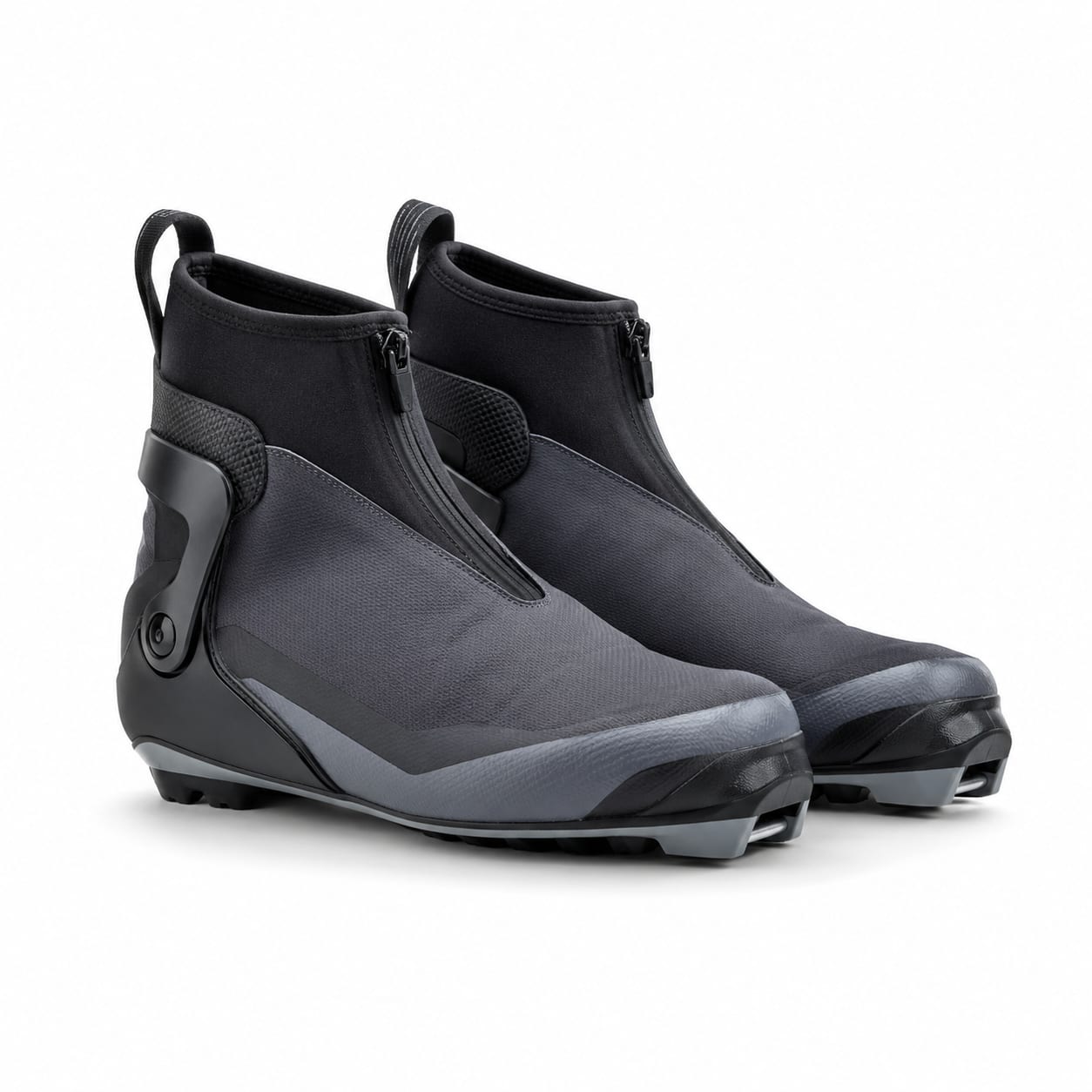
Nordic/cross-country boots are a distinct category not covered by the alpine-focused boot type enum. Within Nordic, sub-disciplines include classic, skate, combi, and backcountry/touring. The closest alpine analog is 'touring' in terms of uphill emphasis, but the construction and binding systems are entirely different.
Compared to other types
Unlike alpine boot types that prioritize downhill control and edge power, Nordic boots prioritize forward motion efficiency, foot flexibility, and lightweight construction. They are incompatible with alpine binding systems and are not designed for downhill skiing.
Why it matters: Choosing the correct Nordic discipline-specific boot is essential because classic, skate, and backcountry boots differ significantly in cuff height, sole flex, and insulation. Using a skate boot for classic skiing restricts ankle motion and reduces kick efficiency; using a classic boot for skate skiing lacks the lateral support needed for effective V1/V2 technique.
Flex Rating (Stiffness)
Flex Rating
What it means
A numerical index indicating how resistant the boot cuff is to forward bending. Higher numbers mean stiffer boots that resist flex more, providing more precise power transfer but requiring more strength and technique to drive.
Typical for this type
Classic: 20-40 (Very Soft); Skate: 50-70 (Moderate); Backcountry: 40-60
Most common pick: 30-50 (Nordic scale)
In practice
Nordic boots are dramatically softer than alpine boots. The flex index scale used for alpine boots (60-150) does not directly apply. Nordic boots prioritize sole flexibility for natural kick and glide. Classic boots are the softest, allowing maximum foot articulation. Skate boots are stiffer through the cuff for lateral support but still have flexible soles. Backcountry boots are moderately stiff for control on descents.
Compared to other types
Nordic boots are 50-80% softer than alpine boots on equivalent scales. Even the stiffest Nordic skate boot is far more flexible than the softest alpine boot, reflecting the fundamentally different demands of cross-country versus downhill skiing.
Why it matters: Sole flex directly impacts kick efficiency in classic skiing and push-off power in skate skiing. Too stiff a sole makes it difficult to compress the ski camber for grip; too soft a cuff in skate boots causes lateral instability. Matching flex to your discipline is critical.
Last Width (Forefoot Width)
Last Width
What it means
The width of the boot shell at the widest point (forefoot/ball area), measured in millimeters. This is the single most important fit dimension for comfort and control.
Typical for this type
98-106mm
Most common pick: 102mm
In practice
Nordic boots tend to have wider last widths than alpine boots because comfort and circulation are prioritized over precision edge control. Typical widths range from 100mm for race-fit models to 106mm for recreational and backcountry models. Feet tend to run colder in Nordic skiing due to lower intensity of impact and less heat generation, so a slightly roomier fit helps maintain warmth.
Compared to other types
Nordic boots run 2-4mm wider on average than comparable alpine boots because precision edge control is less critical and foot warmth is more important. Race-oriented Nordic boots may approach alpine widths (98-100mm), but recreational models are consistently wider.
Why it matters: A boot that is too narrow restricts circulation and leads to cold, numb feet—a serious problem in Nordic skiing where you may be far from shelter. A boot that is too wide allows heel slip during the kick phase, reducing efficiency and causing blisters over long distances.
Volume / Instep Height
Volume / Instep Height
What it means
The overall internal volume and height of the boot through the instep and midfoot area. Categorized as low, medium, or high volume, this affects both comfort and heel hold.
Typical for this type
Medium to High Volume
Most common pick: Medium Volume
In practice
Most Nordic boots are designed with medium to high instep volume to accommodate thicker socks and maintain circulation. The lacing systems on Nordic boots allow more adjustable instep compression than alpine buckles, making medium-volume boots adaptable to a wider range of foot shapes. Backcountry/touring Nordic boots often have high volume for compatibility with thicker socks and added insulation.
Compared to other types
Nordic boots are more forgiving in instep volume than alpine boots because the lacing systems allow finer adjustment and the performance demands are less sensitive to small amounts of heel movement. Alpine boots require precise heel lock for edge control; Nordic boots tolerate slight movement as long as the kick phase remains efficient.
Why it matters: Insufficient instep volume causes pressure points and restricts blood flow, leading to cold feet. Excessive volume causes heel lift during the kick phase. Nordic lacing systems provide more granular adjustment than alpine buckles, so medium-volume boots can often accommodate both low and high insteps with proper lacing technique.
Shell Material
Shell Material
What it means
The primary plastic or composite material used in the boot shell and cuff, which affects weight, stiffness, cold-weather performance, and ease of entry.
Typical for this type
Polyamide/Grilamid For Race And Performance; PU For Backcountry Durability
Most common pick: Polyamide Pa
In practice
Nordic boots frequently use polyamide (Grilamid) or similar lightweight plastics to minimize weight. The lower shells and cuffs are thinner and less rigid than alpine boots. Backcountry/touring Nordic boots may use PU in high-wear areas for durability on rocky or icy terrain. Many Nordic boots also incorporate synthetic leather, textile, or soft-shell materials in the upper, unlike the full-plastic construction of alpine boots.
Compared to other types
Nordic boots use significantly lighter and more flexible materials than alpine boots. Many incorporate textile or soft-shell panels in the upper, which would be unthinkable in alpine construction. This reflects the lower forces involved in Nordic skiing and the priority on weight savings and foot mobility.
Why it matters: Material choice directly affects weight, which is critical in Nordic skiing where each gram is lifted thousands of times per outing. Polyamide saves significant weight over PU but may be less durable for off-trail use. Soft upper materials improve comfort and range of motion but reduce protection compared to full plastic shells.
What it means
The type of inner boot/liner that provides insulation, cushioning, and customizable fit around the foot and ankle.
Typical for this type
Thermo-Formable For Performance; Non-Moldable For Entry-Level; Insulated Comfort Liners For Backcountry
Most common pick: Thermo Formable
In practice
Nordic boots typically use thermo-formable or non-moldable liners. Many mid-range and performance models feature heat-moldable liners that can be customized at a shop. Race-oriented boots may have minimal, lightweight liners that prioritize feel and weight savings over cushioning. Backcountry boots often feature thicker, insulated liners with reflective materials for warmth. Custom foam injection is rare in Nordic boots.
Compared to other types
Nordic boot liners are generally thinner and lighter than alpine liners, reflecting the lower forces and different thermal demands. Insulation is often prioritized over cushioning, and some race Nordic boots have near-minimal liners that would be inadequate for alpine use. Intuition-style aftermarket liners are uncommon in Nordic boots.
Why it matters: Liner choice affects both fit and thermal performance. In Nordic skiing, where feet generate less heat than in alpine skiing, the liner's insulating properties are particularly important. A well-molded liner improves heel hold for efficient kick without creating pressure points that restrict circulation.
Number of Buckles
Buckle Count
What it means
The number of closure buckles on each boot. More buckles provide finer adjustment and more even closure pressure, while fewer buckles save weight and simplify entry.
Typical for this type
Classic: 0 (Laces Only); Skate: 1-2 Buckles + Laces; Backcountry: 2-3 Buckles + Laces
Most common pick: 0-2
In practice
Nordic boots use significantly fewer buckles than alpine boots. Classic boots almost exclusively use lacing systems, sometimes with a quick-pull lace cover. Skate boots commonly add one or two buckles or ratchet straps over the instep and cuff for lateral support. Backcountry Nordic boots may use two to three buckles for a more secure fit on variable terrain. The lace-only approach in classic boots saves weight and allows more even, adjustable closure.
Compared to other types
Nordic boots use far fewer buckles than alpine boots (0-2 vs. 3-4). Lacing systems are the primary closure method, which is rare in modern alpine boots. This reflects the different force profiles: Nordic skiing generates lower forces and requires more uniform closure, while alpine skiing demands high-pressure closure points for edge control.
Why it matters: Fewer buckles mean lighter weight and more even pressure distribution through lacing. However, buckles provide quicker on/off and more precise tension control in specific zones. Skate skiers benefit from buckle-added cuff support; classic skiers generally prefer the simplicity and even closure of laces.
Walk Mode / Hike Mechanism
Walk Mode
What it means
A mechanism that unlocks the cuff from the lower shell, allowing a greater range of forward motion for walking, hiking, or skinning.
Typical for this type
N/A — Nordic Boots Are Inherently Designed For Walking/Striding Motion
Most common pick: True
In practice
Walk mode as a separate mechanism is not applicable to Nordic boots because they are fundamentally designed for forward motion from the outset. The cuff (if present) allows free forward flex at all times. There is no lock/unlock mechanism because Nordic skiing requires continuous ankle articulation. Some backcountry Nordic boots may have a walk/ski mode switch for modest downhill control, but this is uncommon.
Compared to other types
Alpine and freeride boots require a walk mode mechanism because their default state locks the cuff for downhill performance. Nordic boots have no such mechanism because their default and only state is optimized for forward motion. Backcountry Nordic boots may include a cuff lock for modest descents, but this is the exception rather than the rule.
Why it matters: The absence of a walk mode mechanism is actually an advantage—Nordic boots provide unrestricted forward flex by design, which is the default state alpine boots attempt to replicate with walk mode. This inherent mobility is what makes Nordic boots efficient for striding and skating.
Walk Range of Motion (Degrees)
Walk Range of Motion
What it means
The total range of forward cuff rotation when in walk mode, measured in degrees. Greater range makes walking, skinning, and hiking easier and more natural.
Typical for this type
Classic: 70+ Degrees (Essentially Unrestricted); Skate: 50-60 Degrees; Backcountry: 40-55 Degrees
Most common pick: 60+ degrees
In practice
Nordic boots offer far greater forward flex range than any alpine boot with walk mode engaged. Classic boots, with their low or absent cuffs, provide nearly unrestricted ankle flex. Skate boots limit range slightly through their higher cuffs but still offer 50-60 degrees. Backcountry boots with taller cuffs may offer 40-55 degrees. The high range of motion is essential for efficient diagonal stride and skate push-off technique.
Compared to other types
Nordic boots offer 50-100% more range of motion than the best alpine touring boots in walk mode (typically 50-70 degrees vs. 25-60 degrees for AT boots). This reflects the fundamental difference in purpose: Nordic skiing is built around continuous forward motion, while AT boots must balance uphill mobility with downhill performance.
Why it matters: Greater range of motion directly translates to more efficient technique. In classic skiing, unrestricted ankle flex allows a longer, more powerful kick. In skate skiing, adequate forward lean enables proper body positioning for V1 and V2 techniques. Restricted motion forces compensatory technique changes that reduce efficiency and increase fatigue.
Boot Sole Length (BSL)
Boot Sole Length
What it means
The length of the boot sole in millimeters, critical for binding setup and adjustment. Different from mondo point size; the same size boot can have different BSL across brands.
Typical for this type
265-310mm (size-dependent)
Most common pick: 280mm (varies by size and brand)
In practice
Nordic boot sole lengths are generally shorter than alpine boots of the same mondo size because the sole extends less beyond the foot. BSL is determined by size and is not a selectable dimension. However, it is critical for binding compatibility—NNN, Prolink, and SNS bindings must be matched to the boot's sole profile and length. Unlike alpine bindings that adjust to a wide BSL range, Nordic bindings are more size-specific in their fit.
Compared to other types
Nordic boot BSL values are similar to alpine boots of equivalent mondo size but are not interchangeable. The sole profiles are completely different—Nordic soles have flex grooves and binding interfaces that are incompatible with alpine bindings. Never attempt to use a Nordic boot in an alpine binding or vice versa.
Why it matters: Nordic binding systems require the boot sole to engage precisely with the binding plate. Incorrect BSL or sole profile can result in poor binding engagement, prerelease, or failure to lock in. Always verify that your boot's sole standard matches your binding type and that the binding is adjusted for your boot length.
Forward Lean Angle
Forward Lean Angle
What it means
The angle of the cuff relative to vertical, positioning the skier's body forward over the skis. Affects stance, balance, and the ability to drive the ski tips.
Typical for this type
Classic: 3-7 Degrees (Minimal); Skate: 8-12 Degrees; Backcountry: 5-10 Degrees
In practice
Nordic boots have much less forward lean than alpine boots because cross-country skiing requires a more upright stance. Classic technique especially demands an upright posture for efficient weight transfer and kick timing. Skate technique uses slightly more forward lean to engage the ski edges during the push phase. Forward lean in Nordic boots is largely determined by the cuff angle in skate and backcountry models, while classic boots with no cuff have minimal built-in lean.
Compared to other types
Nordic boots have 30-60% less forward lean than alpine boots (5-12 degrees vs. 14-20 degrees). This reflects the upright, endurance-oriented nature of cross-country skiing versus the aggressive, forward-driving stance of alpine skiing. Nordic skiers spend hours in their boots, so a more natural stance reduces fatigue.
Why it matters: Excessive forward lean in a Nordic boot forces an unnatural stance that fatigues the calves and reduces kick efficiency. Too little lean in a skate boot makes it difficult to achieve the forward body position needed for effective skate pushes. The right forward lean supports natural technique without forcing compensatory movements.
GripWalk Sole Compatibility
GripWalk Sole Compatibility
What it means
Whether the boot features a GripWalk sole profile (rockered, rubberized) that requires GripWalk-compatible bindings for safe use.
Typical for this type
NNN/Prolink Sole (Standard For Nordic); SNS (Legacy); Turnamic (NNN-Compatible)
Most common pick: Tech Touring
In practice
Nordic boots do not use GripWalk or alpine DIN soles. They use dedicated Nordic sole standards—NNN (New Nordic Norm), Prolink, or SNS (older Salomon system)—that are incompatible with alpine bindings. NNN and Prolink share the same sole profile and are functionally interchangeable on most modern bindings. SNS uses a different interface and is being phased out. Some backcountry Nordic boots feature rugged, lugged soles for off-trail walking but still use NNN/Prolink binding interfaces.
Compared to other types
Nordic sole standards are completely separate from alpine sole standards (DIN, GripWalk, WTR, Tech). There is no cross-compatibility between Nordic and alpine binding systems. Nordic soles are designed for flex and lightweight engagement; alpine soles are designed for rigidity and retention under high forces.
Why it matters: Binding-boot compatibility is non-negotiable in Nordic skiing. Using a boot with the wrong sole standard for your bindings will result in failure to engage or unsafe release. NNN and Prolink are the current standards and are cross-compatible. SNS is legacy and should be avoided for new purchases unless you already own SNS bindings.
Weight Per Pair (grams)
Weight Per Pair
What it means
The total weight of both boots in grams. Weight significantly affects touring efficiency and all-day fatigue, with lighter boots being easier on the uphill but sometimes sacrificing downhill performance.
Typical for this type
Race Classic: 800-1000g; Race Skate: 1000-1200g; Recreational: 1200-1500g; Backcountry: 1500-2000g
In practice
Nordic boots are dramatically lighter than alpine boots, with most pairs weighing between 800 and 2000 grams. Race-oriented classic boots are the lightest, sometimes under 400 grams per boot. Recreational and backcountry models are heavier due to added insulation, more robust construction, and additional closure features. Weight matters enormously in Nordic skiing because each foot is lifted and propelled forward thousands of times per outing.
Compared to other types
Nordic boots are 50-75% lighter than alpine boots (800-2000g vs. 3200-5000g per pair). This weight difference reflects the fundamentally different demands: Nordic skiing is an endurance activity where every gram matters, while alpine skiing prioritizes power transmission and protection over weight savings.
Why it matters: In Nordic skiing, weight is arguably the most important performance metric after fit. Every 100 grams saved per boot reduces fatigue over long distances and improves kick efficiency. However, the lightest boots sacrifice insulation, durability, and support. Recreational skiers should prioritize comfort and warmth over weight savings; competitive skiers should seek the lightest boots that still provide adequate support.
Micro-Adjustable Buckles
Micro-Adjustable Buckles
What it means
Whether the buckles can be fine-tuned with a screw mechanism for precise tension adjustment beyond the standard catch positions.
Typical for this type
Rare In Nordic Boots; Some Skate And Backcountry Models May Feature Micro-Adjustment On Cuff Buckles
Most common pick: False
In practice
Micro-adjustable buckles are uncommon in Nordic boots because most models use lacing systems rather than buckles. The few Nordic boots that include buckles—typically skate or backcountry models—may feature micro-adjustment on the cuff buckle for fine-tuning lateral support. However, lacing provides inherently adjustable closure that makes micro-adjustment less necessary.
Compared to other types
Micro-adjustable buckles are standard on mid-range and above alpine boots but rare in Nordic boots. This reflects the different closure philosophies: alpine boots use buckles for high-pressure closure points, while Nordic boots use laces for even, low-pressure closure across the entire foot.
Why it matters: Lacing systems offer more granular and even adjustment than buckle systems, making micro-adjustment less critical. If your Nordic boots have buckles, micro-adjustment is a nice feature for fine-tuning cuff tension, but it should not be a primary purchasing consideration.
Power Strap Type
Power Strap
What it means
The velcro or mechanical strap at the top of the cuff that provides additional closure power and fine-tuning of upper cuff tension.
Typical for this type
Classic: None; Skate: Standard Or Wide Velcro Strap; Backcountry: Standard Velcro Strap
Most common pick: Standard Velcro
In practice
Power straps are only found on Nordic boots with cuffs—primarily skate and backcountry models. Classic boots, which lack cuffs, do not have power straps. Skate boots may include a velcro strap at the top of the cuff for additional closure power and lateral support. Backcountry boots sometimes feature a strap for a more secure fit on variable terrain. The straps are typically standard-width velcro, as the forces involved are much lower than in alpine skiing.
Compared to other types
Power straps in Nordic boots serve a less critical role than in alpine boots because the forces are lower and the closure demands are different. Alpine power straps prevent cuff separation under high forward pressure; Nordic straps simply fine-tune cuff fit. Mechanical/buckle straps found on race alpine boots are not used in Nordic boots.
Why it matters: A power strap on a skate boot provides additional cuff closure that enhances lateral support during V1 and V2 pushes. On backcountry boots, it helps secure the fit on uneven terrain. For classic boots, a power strap is unnecessary because there is no cuff to secure. This is a minor feature in the Nordic context.
Cuff Alignment / Cant Adjustment
Cuff Alignment Adjustment
What it means
The ability to adjust the lateral angle of the cuff relative to the lower shell, accommodating bowlegged or knock-kneed stances for proper edge engagement.
Typical for this type
Not Available On Most Nordic Boots; Some High-End Skate Boots May Offer Limited Cuff Cant Adjustment
Most common pick: False
In practice
Cuff alignment adjustment is rare in Nordic boots because edge control precision is less critical than in alpine skiing. Most Nordic boots either lack a cuff entirely (classic) or have a simple, non-adjustable cuff (skate and backcountry). A few high-end skate boots offer limited cuff cant adjustment for skiers with significant alignment issues who need to optimize their push angle.
Compared to other types
Cuff alignment is a common and important feature on performance alpine boots but nearly absent in Nordic boots. This reflects the different demands: alpine skiing requires precise edge engagement on steep terrain, while Nordic skiing prioritizes forward motion efficiency where minor alignment issues are less impactful on performance.
Why it matters: For the vast majority of Nordic skiers, cuff alignment is not a concern. If you have significant bowlegged or knock-kneed stance that affects your skate technique, a bootfitter may be able to modify the cuff or recommend a model with adjustment. Otherwise, this feature is not worth seeking out in Nordic boots.
Recommended Skill Level
Recommended Skill Level
What it means
The skier ability level the boot is designed and optimized for, which correlates with flex, features, and overall construction philosophy.
Typical for this type
Beginner to Expert (Nordic-Specific Skill Levels Apply)
Most common pick: Intermediate
In practice
Nordic boots are available for all skill levels, but the skill classification differs from alpine skiing. Beginner Nordic boots are softer, wider, and more comfort-oriented with minimal cuffs. Intermediate boots offer better support and more precise fit. Advanced/expert Nordic boots are lighter, stiffer through the cuff (skate), and feature performance-oriented liners and closure systems. Race-level boots are ultra-light with minimal padding and demand precise technique.
Compared to other types
Nordic skill levels parallel alpine levels in structure but apply to entirely different techniques. An expert alpine skier may be a beginner Nordic skier and vice versa. Nordic boot flex and performance scales are different—what constitutes 'stiff' in Nordic is still far softer than alpine. Don't assume your alpine ability translates directly to Nordic boot selection.
Why it matters: Choosing a Nordic boot that matches your skill level ensures you get the right balance of comfort and performance. A beginner in a race-level boot will find it uncomfortable and unforgiving; an expert in a beginner boot will lack the support and responsiveness needed for efficient technique. Be honest about your Nordic skiing ability, which may differ significantly from your alpine ability.